A New Online Home for Design Faith Blog

I have moved the Design Faith blog to my relaunched website kennethcaldwell.com You'll be redirected there in 10 seconds.

Thursday, February 28, 2013

Some Notes on Mass Customization

A few years ago, I started writing a piece on mass customization. How do well-funded companies make consumers feel like individuals? Recently I was in Palm Springs and wondered, how did the Alexander Company, developer of all those modernist tract homes, figure out this challenge? Most of these small houses (about 1,200 square feet each) had the same plan yet felt unique and even spacious. My friend Jill Pilaroscia, a colorist, has been hired to carefully plan the coloring of new subdivisions in Silicon Valley so homebuyers feel that they are purchasing a unique product. But in this age of advanced algorithms, developers are probably using a great deal more than color and design to make us feel special.


You have to admit, the phrase “mass customization” seems like an oxymoron. Indeed, the concept captures the benefits and drawbacks arising from technology’s evolution. During the industrial revolution, economies of scale in production and distribution led to mass production. Yet the Internet era, with texting, tweeting, and blogging, appears to celebrate the individual voice. Retailers are embracing the concept of mass customization, but how might it apply to the real estate development world?

There are probably all kinds of software that help developers determine where the “heat” is, whether for condo developments or retail centers. But do developers understand that the basic issue is existential in nature? In an era of corporate homogenization, how does the individual feel recognized or seen? Are we all going to be victims of someone who understands us better than we understand ourselves?

Mass customization specifically refers to a process that allows providers of goods and services to enjoy the economies of scale that mass production allows while appearing to customize the product or service to the individual’s preferences. Well-known examples include the Mini Cooper, which allows customers to select options for the automobile they are ordering, and Adidas tennis shoes. Fundamentally, these kinds of customization are limited because they offer predetermined mass-produced products that the consumer can alter slightly. Middlebrow clothing manufacturers such as L.L. Bean, Land’s End, and My Virtual Model allow buyers to customize different outfits for a sense of greater control. Even high-end designers such as Louis Vuitton have also embraced the new technology—at premium prices. Perhaps the most familiar twist has been Amazon’s website, which analyzes browsing and purchasing habits and suggests a book or other product to purchase. It feels custom, although of course it is done entirely by a computer program.

Monogram collection
courtesy louisvuitton.com

Developers and manufacturers can differentiate themselves in a depressed economy by applying ideas drawn from the concept of mass customization. In the simplest of terms, this means listening to consumers and respecting their opinion and their need for individuality. Frank Piller, a German professor and founding faculty member of the MIT Smart Customization Group, wrote on his blog, Mass Customization & Open Innovation News, that attendees at the 2009 Conference on Mass Customization and Personalization (MCPC) see mass customization as the solution to the downturn. This recession differs from the depression of 1929 because there is cash waiting to move. While banks may be restricting lending, wealthy families and individuals are just waiting for real estate prices to drop to even lower levels before they act. This means there will be a new generation of developers, and they will be likely younger and more technologically savvy.

Daniel Schodek, a professor at Harvard and coauthor of the 2004 book Digital Design and Manufacturing: CAD/CAM Applications in Architecture and Design, wrote in some detail about mass customization in the construction products market in a 2005 article for Architecture Week. He brought up the challenge of legality issues, shop drawings, and volume. It’s one thing to modify a high-end handbag, but quite another to alter a window assembly. But this may not be the right scale of intervention. Real estate developers don’t need their clients digging that far into the details, they need more information on basic preferences, which may be more amenable to a process like mass customization.

We have already seen some desire to move away from homogeneity with retail centers moving downtown or becoming pedestrian oriented. The fickle public, glued to rapid visual entertainment, tires of anything gimmicky and wants what it imagines as authentic. However, Berkeley’s famed Fourth Street, studied by retail developers all over, cannot be reproduced in an exurban convergence of highways. With the bankruptcy of major players in the development field, like General Growth, a new generation of land developers will likely arise who are going to be able to cherry-pick preferred demographics and locations and who will begin using new ways of thinking about communicating with their constituencies—perhaps while they are designing.

courtesy fourthstreetshop.com

courtesy fourthstreetshop.com

The obvious opportunity for the development community is in the sale of multifamily housing. Internet sales tools could allow potential buyers to see the views from a unit and the quality of light as well as select various developer finishes and aligned furnishings (such as Design Within Reach or Ethan Allen) to generate an accurate rendering of their potential home.

Single-family home developers have been reluctant to allow their purchasers to select color or alter architectural styles. What would happen if they used new technologies to inform buyers as they began selling homes? Can they move some decisions further along the supply chain in order to partially customize the product and gain valuable information for future projects? In other words, the customer becomes a participant in the design process. According to an article in the MIT Sloan Management Review, when Italian automobile manufacturer Fiat was developing its hip new/old 500 model, it created a forum where thousands of customers commented on the emerging design and engaged in dialog with each other. What if developers reached out to their potential audience in this way before building? There has been some move in the direction of mass customization in Europe and Asia. In Almere, Netherlands, in the early 2000s, district planners created an extension to the city by bringing in more than a dozen builder/architect teams, each assigned the task of creating flexible housing types that would take into account buyer preferences. The idea was that buyers could choose to add or subtract predesigned extensions to their unit. Building regulations did not allow full implementation of the concept, however.

courtesy afewthoughts.co.uk

The next obvious step would be high-end prefabrication that permits several permutations. Might manufactured home companies like Santa Monica–based LivingHomes move into the development business? Philadelphia-based architecture firm KieranTimberlake put forward Cellophane House, included in the New York Museum of Modern Art’s Home Delivery: Fabricating the Modern Dwelling exhibit a few years ago, as a potential model for mass customization of housing. The house’s design is intended to accommodate a variety of options in materials, layout, and size. Likewise, Los Angeles firm Marmol Radziner has come up with its own versions of customizable prefabricated housing that have attracted some press attention. But modifying a few unique houses won’t offer the kind of test that developing an entire community will.

courtesy marmolradzinerprefab.com

courtesy marmolradzinerprefab.com

New developments in technology will allow developers to reach out and gain information about potential clients. For example, Web morphing is a process that allows a site to identify a user’s cognitive styles and adjust the site to adjust to those styles. This may help the developer to both attract the interest of the buyer and also gain information on his or her preferences.

Applying mass customization to real estate development will likely require developers to see a longer horizon and to include feedback from buyers. If new developers are not publically traded companies, they have more flexibility in terms of the timing of returns.

This will require a new mindset, one that understands mass customization first as a process rather than a product. This will likely take place with new actors who bring new ideas to a recovering market. Hopefully, some of them will still want to communicate to individuals.

Thursday, February 7, 2013

Postcard from Roosevelt Island, New York

Freedom & Choice


One friend said, “It looks a bit austere.” At first glance, it probably is. But like so many great minimal environments, it asks for patience and generosity. You give, and in turn it gives back.

This is also what the artists Mark Rothko, Richard Serra, Donald Judd, and, more recently, Olafur Eliasson ask. Trust them with your time and you may be rewarded with a small measure of serenity—perhaps even with the connection between art and the divine that Dominique de Menil was so focused on.

Designed by Louis Kahn, the Franklin D. Roosevelt Four Freedoms Park is an outdoor sanctuary at the southern tip of what is now called Roosevelt Island, created as a memorial to FDR. The park opened last fall. Kahn’s gift took 40 years to be realized, but it presents a path for human beings to treat each other to peace.


They couldn’t have been more different: Roosevelt, the Brahmin from Hyde Park, and Kahn, the immigrant from a small Baltic country that endured centuries of foreign rule. And yet they couldn’t have been more similar. Their fundamental vision was a very long one. Roosevelt was trying to save the world for eternity, and Kahn was trying to build places that might transcend time.

This memorial contrasts with Lawrence Halprin’s narrative-heavy memorial to FDR in Washington, D.C. Each memorial celebrates something different. In a city of marble mausoleums, Halprin’s meandering rooms provide an antidote and a history lesson. Across from midtown Manhattan and the U.N., in the middle of the East River, Kahn’s memorial also provides an antidote. A place to pause, revere, and rededicate.


The inscription in the stone is taken from FDR’s famous speech of January 6, 1941:

In the future days, which we seek to make secure, we look forward to a world founded upon four essential human freedoms.

The first is freedom of speech and expression—everywhere in the world.

The second is freedom of every person to worship God in his own way—everywhere in the world.

The third is freedom from want—which, translated into world terms, means economic understandings which will secure to every nation a healthy peacetime life for its inhabitants—everywhere in the world.

The fourth is freedom from fear—which, translated into world terms, means a world-wide reduction of armaments to such a point and in such a thorough fashion that no nation will be in a position to commit an act of physical aggression against any neighbor—anywhere in the world.

That is no vision of a distant millennium. It is a definite basis for a kind of world attainable in our own time and generation.

The inscription reproduced in the new park ends with the word “generation,” omitting the second half of the speech. This truncation must be intentional for reasons beyond space. For example, the phrase, “…and its faith in freedom under the guidance of God” is left out. Perhaps in our secular era, God is left up to the interpretation of each individual.


To achieve these freedoms, we must spend some time alone with ourselves and understand our common purpose. That is what these sequences of spaces can offer everybody.


When the park opened, many of the reviewers wrote about the materials and placement of the stones in the chamber at the conclusion of the journey, a chamber with no roof and the one wall open to the vista out across the water. But the journey to this place of reflection is also worth thinking about. It offers many choices. You can mount the stairs without a clear idea of the conclusion and then proceed down either side of a dramatic allĂ©e of trees towards FDR’s statue and the outdoor room. Or you can choose a gentle ramp up the west or east side of the memorial, watching the river but not seeing the destination. All choreographed carefully, but no clear path. I think Kahn’s point is simple. There are different paths to freedom, but we have to choose one and ultimately reckon in some way with ourselves.


Please be sure and check the website for current hours. The park is not open every day.

http://www.fdrfourfreedomspark.org/

Friday, January 4, 2013

Best of 2012

I was going to try and write the Best of 2012 blog in chronological order, because then the images on my Facebook diary could guide me. But that didn’t work, because I had to start with the best thing that happened in 2012!

Favorite Election
The best thing about 2012 was the reelection of Barack Obama. I don’t idolize him, but this was a choice between existence and extinction. I think that deep down, he wants to do what’s right. He understands the needs of the 99% better than any president since FDR. We look forward to the closing of Guantanamo and to gun control! Not to mention general human rights.


Favorite Action in the World
Moving from the global to the personal, I often ask myself, what can be done in the world? The answer is often local and sometimes very personal. Our friends David and Jay began adopting two wonderful kids. We love being around them and got to share in their first Halloween, Christmas, and New Year’s together. What they are doing moves me very deeply.


Favorite Blog
David has been writing about their experience, which leads us to my favorite blog of this year. Reading www.seekingfatherhood.com will make you laugh and cry and renew your faith in human nature.

Favorite Restaurant
This year, we didn’t try many new restaurants. However, I did enjoy St. Vincent in the Mission. No pyrotechnics, but quite good. Big focus on wine.
http://www.stvincentsf.com/about/


Favorite Breakfast Spot in New York
I have eaten at Maialino in Gramercy Park several times for lunch and dinner, but didn’t even know they served breakfast. It’s very close to the apartment where I often stay in New York.

Courtesy maialinonyc.com

Favorite New Hotel (outside US)
Kylesku Hotel in the Scottish Highlands is one of those modest hotels run by people who care. It isn’t luxurious, but the ladies who own it have a simple design sensibility and have hired enthusiastic young folk in the kitchen and dining room. And the view over the lochs is delightfully eerie. We loved it.
http://www.kyleskuhotel.co.uk/www.kyleskuhotel.co.uk/Welcome.html


Favorite New Museum
Piers Art Centre
We also discovered this place on our trip to Scotland. This small museum in Orkney consists of two historic buildings and one new one—all beautifully knit together. We loved the art collection, but also the place.

The institution was created with Margaret Gardiner’s collection. She lived in St. Ives and befriended artists such as Barbara Hepworth, Ben Nicholson, and Patrick Heron. Eventually she bought a place on one of the Orkney Islands. Her son suggested that she donate her collection to the people of Orkney, and this exquisite museum was born. It is located in Stromness right on the water. A must-see on your visit to Orkney when you attend the St. Magnus Festival!
http://www.pierartscentre.com/


Favorite Cathedral and Favorite Music Festival
Speaking of Orkney, we loved the St. Magnus Cathedral, site of Paul’s new work commissioned by the St. Magnus Festival. The cathedral was built in 1137 and belongs to the people of Orkney, not the church. An excellent venue for music and meditation.
http://www.stmagnus.org/
http://www.stmagnusfestival.com/


Favorite New Sculpture Park
Yorkshire Sculpture Park
One of the surprises of our trip to the UK this year. A simple entry building with vast interior sculpture galleries and then hundreds of acres of the Yorkshire countryside filled with modern sculpture. We especially liked the James Turrell piece, of course.


Favorite Writers Retreat
In a world of ambition, it is useful to write for self-exploration. Chris DeLorenzo leads workshops that nurture. On a whim, I went to his retreat in Puerto Vallarta in January, and, to borrow a phrase from the human potential movement, it was transformational. Not only did I find out things about myself, but I also learned to let go of judgment—well, a little. He also holds one-day retreats throughout the year.
http://www.laguna-writers.com/


Favorite Masseur
My pals David and Yosh suggested Mark Haviland, who comes to David’s office for chair massages and also has a private clientele. He has been fantastic. He is guided by something different than most of us. He is now off to India and Africa to share his gifts with those who might not otherwise enjoy them. He will be back in March!
beyondbodywork@gmail.com

Favorite New Memorial
Louis Kahn’s design survived intact for 40 years. It is sublime. There will be a full post in the near future. In the meantime:
http://www.fdrfourfreedomspark.org/


Favorite New Beach
I finally got to Fire Island Pines at 54. I wasn’t the oldest guy on the beach, but.… The restaurants aren’t good, but the long walks along boardwalks and the endless sand and warm ocean make it a perfect place to forget the world. Although the Pines suffered some damage in Hurricane Sandy, no houses were lost. Fire Island isn’t an island at all, but just a sand bar that will disappear one day.


Favorite Art Exhibit
The Matisse show at the Metropolitan reminds me how radical he was. It’s there through the middle of March.
http://www.metmuseum.org/exhibitions/listings/2012/matisse

Courtesy metmuseum.org

Favorite New Retail
Speaking of David and Yosh, the best new retail isn’t quite retail. It’s more like an experiment. David and Yosh have opened something called Storefront Lab. They are changing the world one retail idea at a time.
http://www.storefrontlab.org/


Favorite Fashion Show
Last year it was Alexander McQueen in New York. While not as radical or lavish, Jean Paul Gaultier’s show at the de Young Museum was like a long wonderful dream.
http://deyoung.famsf.org/deyoung/exhibitions/fashion-world-jean-paul-gaultier-sidewalk-catwalk


Favorite Diary
Last year it was The Sixties: Diaries 1960–1969 by Christopher Isherwood. This year it is the next volume, covering 1970 to 1983. The title is Liberation. A good theme for 2013.
http://www.randomhouse.com.au/books/christopher-isherwood/liberation-diaries-vol-3-9780701184490.aspx


Courtesy randomhouse.com

Favorite Evolving Design-Related Online Magazine
Architizer has a new editor, Jenna McKnight, and is adding more content every week. Check it out.
http://www.architizer.com/en_us/

Favorite Old Retail Emporium
Placewares in Gualala captures all that was great about design retailing in the 1960s—Design Research! No surprise, given that the owners, Maynard and Lu Lyndon, were at D/R before founding their own company back in Boston. Next to Sea Ranch, they sell all the right stuff for your Sea Ranch house, including loads of Marimekko! It’s no wonder they get the Sea Ranch aesthetic—Maynard’s brother Donlyn was one of the original architects and also designed Maynard and Lu’s cool house.
www.placewares.com


Favorite House at Sea Ranch
Speaking of Sea Ranch, I am writing this from Barry Elbasani’s recently completed house at Sea Ranch. He bought the lot back in the 1960s and talked about designing this house ever since I met him in 1990. He never saw it finished, but I think he would be thrilled.


Happy New Year! Hoping for more good change in 2013.

Monday, November 12, 2012

Postcard from Ahmedabad


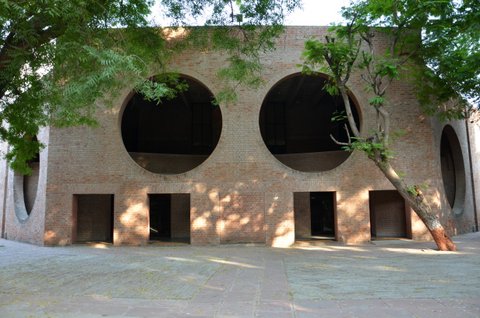
I did not go to India. And it looks like it will take me a while to get there. So we rely on the kindness of our friends to tell us of their adventures. My friend Janette Gross and I worked together at ELS Architecture and Urban Design for several years in the 1990s. Now retired, she focuses on textiles, weaving, and travel. She just returned from India and sent me a few photos of her visit to Louis Kahn’s Indian Institute of Management in Ahmedabad. I asked her for more.

Not surprisingly, the line to Kahn’s Indian Institute of Management goes back to Le Corbusier. But it goes through an Indian architect who is not well known in this country, Balkrishna Vithaldas Doshi (1927–2010). B.V. Doshi, who makes a guest appearance in Nathaniel Kahn’s film My Architect, and is the subject of his own documentary, worked closely with Le Corbusier on Chandigarh.

Doshi respected Le Corbusier but knew that his modernist forms did not really respond to India as a place. When offered the commission for the Indian Institute of Management, Doshi persuaded the powers to hire Kahn as “consulting architect.” Doshi probably knew that Kahn could design a building that would bring ideas from America (Harvard Business School, to be precise) and would be sensitive to India’s harsh climate, bountiful landscape, and labor-intensive building traditions, while at the same time reaching beyond its time or place. Kahn’s design began in 1962 and was constantly revised until completion in 1974.

Janette’s snapshots from October show a place that could have been built before the practice of architecture even existed. In a story recounted in Carter Wiseman’s biography, Louis I. Kahn: Beyond Time and Style, Doshi told Kahn that portions of the project resembled an Indian temple from the 15th century. Kahn’s mature work was reaching toward the eternal.

Q: Why did you go to India?

A: I went on a Slow Fiber Tour with artist/textile expert Yoshiko Wada, who’s based in Berkeley.

Q: How did you know about Kahn’s Indian Institute of Management?

A: Yoshiko lived in India for a while and became very familiar with the architectural gems in Ahmedabad. Although our focus was textiles, she included the Indian Institute of Management, the National Institute of Design (where we spent one night, had dinner with two of the directors, toured the campus, and looked at the students’ work), an underground art gallery designed by B.V. Doshi on the campus of the Center for Environmental Planning and Technology University, and a restored historical home in an old section of the city. We were also scheduled to visit a private Le Corbusier home, but the owner was ill and couldn’t receive us.

Q: Can you describe your feelings moving through the IIM?

A: The IIM campus was a bit of a shock at first. I was surprised by the brick. My limited experience with Kahn made me expect concrete. It was also so big and open and clean, which was drastically different from the crowded, gritty, chaotic hustle and bustle of Ahmedabad. We visited on a Sunday, so there weren’t many students or activities. But as we moved through the campus, many of us realized that we were feeling calmer and could breathe easier. It is definitely an oasis from the city. The buildings are well maintained and the landscaping is lovely. The light could change the buildings so drastically. When the sun was not shining on a building, it appeared dreary and very institutional. But when the sun shone through the portholes or down a corridor, the building was completely changed. The angles and shadows made everything warmer and come alive.


Q: Did you go on a tour?

A: We did not take a tour and had only a short amount of time to run through, snapping as many photos as we could at every amazing corner we turned! It would have been wonderful to have had someone walk through with us to educate us. As it was, we just took it in without any explanation.

Q: Did it feel like boxes within boxes?

A: I didn’t feel that so much. But I definitely noticed how the massiveness of the buildings was tempered by all the cutouts to the outside, some low at eye level and others high up opening up to the trees. I did wonder how different it would be without the lush plantings and trees. I was also intrigued by all the odd angles. Some were very puzzling—why were they there? They didn’t appear to be for aesthetics or light play or views. Like a narrow opening that seemed to be a light well, cutting through all the floors. But there appeared to be doors opening into it, and I couldn’t figure out why anyone would open the door and walk into this narrow, dark shaft. It became clear that you probably had to go inside the rooms to understand it, and we were not able to do that.


Q: Did anybody who worked or studied there tell you what they thought of the building?

A: That would have been great, if we’d had the opportunity. Especially in the student housing, which looked very dreary from the outside. As I mentioned, it was a Sunday, so it was pretty quiet. There also were guards in the lecture hall building, and they wouldn’t let us enter a particular hallway while a lecture or meeting was in session.

Q: What was it like to stay overnight in the dorms designed by B.V. Doshi at the Institute for Design?

A: I believe the rooms we stayed in were for visiting faculty. Our room had two beds, a closet, a desk, a bathroom, and windows on both sides. Each floor had two bedrooms, I believe, as well as a kitchen, a small common eating area, and a living room. At night we had food brought in, which was dished out in the kitchen and eaten in the living room while we chatted with two of the faculty.

Institute of Design by B.V. Doshi

All photos by Janette Gross.

Other Resources
http://www.myarchitectfilm.com/
http://www.iimahd.ernet.in/

Wednesday, November 7, 2012

The Country Was Saved. Now It’s Time for a Revolution.

courtesy www.barackobama.com
The country was saved. Barely. From our vantage point in the liberal Bay Area, it is difficult to understand how half the country could vote for someone who, as I have said before, was basically a brown shirt in a rep tie. Or, at least, was advocating extreme right-wing madness. Sometimes it seems so complicated that I turn off and go back to listening to Leonard Cohen. Let’s go live on a Greek Island with a mistress of one kind or another for a while.

But basically it is the end of the hegemonic order and the unchecked power of the one percent. Citizens United meant that rich folks without values could run around doing whatever they wanted. That is, until a bloody revolution stopped it all. But that is not the preferred outcome. Almost every country with any kind of economic strength has a jumbled-up combination of socialism and capitalism. The question is, how much does the government check greed, and how? Large countries that said they embraced socialism, like China and the USSR, didn’t. And when they embraced capitalism, it became government-sanctioned thievery. Most of Europe has embraced socialism and allows capitalism to flourish as long as the basic needs of the citizens are met. Of course, that is no longer true in the US; the standard of living in several countries is better than ours. (Not that ours should be the best.)


We are confronted with a radically changing demographic. The era of the white man is almost over. Although minorities of all kinds are still oppressed by the right and the religions that cater to the right, the long arc of justice that Martin Luther King, Jr. talked about will happen. But the few straight white men who control the levers of capitalism are not going to give up without a fight. These few people outspent the Democrats and told lies and more lies in every possible media channel they could think of. There are reports that they tried to disrupt the voting process. The outcome of this election is so important because the Supreme Court will change its makeup in the next four years, and now the new justices will say no to the wreckage that the one percent has caused in the financial and oil industries.

courtesy www.ownieu.owni.fr 

But there are two tracks. There is the political track and the in-the-streets track. The Republicans will still control the House and will keep taking their kind of bribes. This is why we voted for Obama and will be in the streets in the coming years. We will see precious little happen in the political realm, because the Republicans and their corporations will pour their resources into resisting humane progress at every turn. And that’s why Occupy will be back. Next time it won’t be quite as ragtag and stinky. It will be slightly less democratic and slightly more organized. And it will push Wall Street into the gutter. When oil is no longer the blood of the economy and bankers are accountable, we can rebuild a country that is based on human dignity and the idea of service. It can’t happen under a Republican administration. What remains to be seen is whether it can happen under a Democratic one. As the political scientist Jodi Dean said the other day, it only takes ten percent of the population to start a revolution. So, ten to one it is. Good odds, even if the one percent has most of the money.

courtesy www.latimesphoto.files.wordpress.com