A New Online Home for Design Faith Blog

I have moved the Design Faith blog to my relaunched website kennethcaldwell.com You'll be redirected there in 10 seconds.

Friday, January 4, 2013

Best of 2012

I was going to try and write the Best of 2012 blog in chronological order, because then the images on my Facebook diary could guide me. But that didn’t work, because I had to start with the best thing that happened in 2012!

Favorite Election
The best thing about 2012 was the reelection of Barack Obama. I don’t idolize him, but this was a choice between existence and extinction. I think that deep down, he wants to do what’s right. He understands the needs of the 99% better than any president since FDR. We look forward to the closing of Guantanamo and to gun control! Not to mention general human rights.


Favorite Action in the World
Moving from the global to the personal, I often ask myself, what can be done in the world? The answer is often local and sometimes very personal. Our friends David and Jay began adopting two wonderful kids. We love being around them and got to share in their first Halloween, Christmas, and New Year’s together. What they are doing moves me very deeply.


Favorite Blog
David has been writing about their experience, which leads us to my favorite blog of this year. Reading www.seekingfatherhood.com will make you laugh and cry and renew your faith in human nature.

Favorite Restaurant
This year, we didn’t try many new restaurants. However, I did enjoy St. Vincent in the Mission. No pyrotechnics, but quite good. Big focus on wine.
http://www.stvincentsf.com/about/


Favorite Breakfast Spot in New York
I have eaten at Maialino in Gramercy Park several times for lunch and dinner, but didn’t even know they served breakfast. It’s very close to the apartment where I often stay in New York.

Courtesy maialinonyc.com

Favorite New Hotel (outside US)
Kylesku Hotel in the Scottish Highlands is one of those modest hotels run by people who care. It isn’t luxurious, but the ladies who own it have a simple design sensibility and have hired enthusiastic young folk in the kitchen and dining room. And the view over the lochs is delightfully eerie. We loved it.
http://www.kyleskuhotel.co.uk/www.kyleskuhotel.co.uk/Welcome.html


Favorite New Museum
Piers Art Centre
We also discovered this place on our trip to Scotland. This small museum in Orkney consists of two historic buildings and one new one—all beautifully knit together. We loved the art collection, but also the place.

The institution was created with Margaret Gardiner’s collection. She lived in St. Ives and befriended artists such as Barbara Hepworth, Ben Nicholson, and Patrick Heron. Eventually she bought a place on one of the Orkney Islands. Her son suggested that she donate her collection to the people of Orkney, and this exquisite museum was born. It is located in Stromness right on the water. A must-see on your visit to Orkney when you attend the St. Magnus Festival!
http://www.pierartscentre.com/


Favorite Cathedral and Favorite Music Festival
Speaking of Orkney, we loved the St. Magnus Cathedral, site of Paul’s new work commissioned by the St. Magnus Festival. The cathedral was built in 1137 and belongs to the people of Orkney, not the church. An excellent venue for music and meditation.
http://www.stmagnus.org/
http://www.stmagnusfestival.com/


Favorite New Sculpture Park
Yorkshire Sculpture Park
One of the surprises of our trip to the UK this year. A simple entry building with vast interior sculpture galleries and then hundreds of acres of the Yorkshire countryside filled with modern sculpture. We especially liked the James Turrell piece, of course.


Favorite Writers Retreat
In a world of ambition, it is useful to write for self-exploration. Chris DeLorenzo leads workshops that nurture. On a whim, I went to his retreat in Puerto Vallarta in January, and, to borrow a phrase from the human potential movement, it was transformational. Not only did I find out things about myself, but I also learned to let go of judgment—well, a little. He also holds one-day retreats throughout the year.
http://www.laguna-writers.com/


Favorite Masseur
My pals David and Yosh suggested Mark Haviland, who comes to David’s office for chair massages and also has a private clientele. He has been fantastic. He is guided by something different than most of us. He is now off to India and Africa to share his gifts with those who might not otherwise enjoy them. He will be back in March!
beyondbodywork@gmail.com

Favorite New Memorial
Louis Kahn’s design survived intact for 40 years. It is sublime. There will be a full post in the near future. In the meantime:
http://www.fdrfourfreedomspark.org/


Favorite New Beach
I finally got to Fire Island Pines at 54. I wasn’t the oldest guy on the beach, but.… The restaurants aren’t good, but the long walks along boardwalks and the endless sand and warm ocean make it a perfect place to forget the world. Although the Pines suffered some damage in Hurricane Sandy, no houses were lost. Fire Island isn’t an island at all, but just a sand bar that will disappear one day.


Favorite Art Exhibit
The Matisse show at the Metropolitan reminds me how radical he was. It’s there through the middle of March.
http://www.metmuseum.org/exhibitions/listings/2012/matisse

Courtesy metmuseum.org

Favorite New Retail
Speaking of David and Yosh, the best new retail isn’t quite retail. It’s more like an experiment. David and Yosh have opened something called Storefront Lab. They are changing the world one retail idea at a time.
http://www.storefrontlab.org/


Favorite Fashion Show
Last year it was Alexander McQueen in New York. While not as radical or lavish, Jean Paul Gaultier’s show at the de Young Museum was like a long wonderful dream.
http://deyoung.famsf.org/deyoung/exhibitions/fashion-world-jean-paul-gaultier-sidewalk-catwalk


Favorite Diary
Last year it was The Sixties: Diaries 1960–1969 by Christopher Isherwood. This year it is the next volume, covering 1970 to 1983. The title is Liberation. A good theme for 2013.
http://www.randomhouse.com.au/books/christopher-isherwood/liberation-diaries-vol-3-9780701184490.aspx


Courtesy randomhouse.com

Favorite Evolving Design-Related Online Magazine
Architizer has a new editor, Jenna McKnight, and is adding more content every week. Check it out.
http://www.architizer.com/en_us/

Favorite Old Retail Emporium
Placewares in Gualala captures all that was great about design retailing in the 1960s—Design Research! No surprise, given that the owners, Maynard and Lu Lyndon, were at D/R before founding their own company back in Boston. Next to Sea Ranch, they sell all the right stuff for your Sea Ranch house, including loads of Marimekko! It’s no wonder they get the Sea Ranch aesthetic—Maynard’s brother Donlyn was one of the original architects and also designed Maynard and Lu’s cool house.
www.placewares.com


Favorite House at Sea Ranch
Speaking of Sea Ranch, I am writing this from Barry Elbasani’s recently completed house at Sea Ranch. He bought the lot back in the 1960s and talked about designing this house ever since I met him in 1990. He never saw it finished, but I think he would be thrilled.


Happy New Year! Hoping for more good change in 2013.

Monday, November 12, 2012

Postcard from Ahmedabad


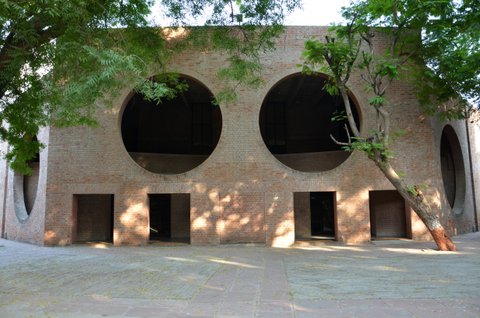
I did not go to India. And it looks like it will take me a while to get there. So we rely on the kindness of our friends to tell us of their adventures. My friend Janette Gross and I worked together at ELS Architecture and Urban Design for several years in the 1990s. Now retired, she focuses on textiles, weaving, and travel. She just returned from India and sent me a few photos of her visit to Louis Kahn’s Indian Institute of Management in Ahmedabad. I asked her for more.

Not surprisingly, the line to Kahn’s Indian Institute of Management goes back to Le Corbusier. But it goes through an Indian architect who is not well known in this country, Balkrishna Vithaldas Doshi (1927–2010). B.V. Doshi, who makes a guest appearance in Nathaniel Kahn’s film My Architect, and is the subject of his own documentary, worked closely with Le Corbusier on Chandigarh.

Doshi respected Le Corbusier but knew that his modernist forms did not really respond to India as a place. When offered the commission for the Indian Institute of Management, Doshi persuaded the powers to hire Kahn as “consulting architect.” Doshi probably knew that Kahn could design a building that would bring ideas from America (Harvard Business School, to be precise) and would be sensitive to India’s harsh climate, bountiful landscape, and labor-intensive building traditions, while at the same time reaching beyond its time or place. Kahn’s design began in 1962 and was constantly revised until completion in 1974.

Janette’s snapshots from October show a place that could have been built before the practice of architecture even existed. In a story recounted in Carter Wiseman’s biography, Louis I. Kahn: Beyond Time and Style, Doshi told Kahn that portions of the project resembled an Indian temple from the 15th century. Kahn’s mature work was reaching toward the eternal.

Q: Why did you go to India?

A: I went on a Slow Fiber Tour with artist/textile expert Yoshiko Wada, who’s based in Berkeley.

Q: How did you know about Kahn’s Indian Institute of Management?

A: Yoshiko lived in India for a while and became very familiar with the architectural gems in Ahmedabad. Although our focus was textiles, she included the Indian Institute of Management, the National Institute of Design (where we spent one night, had dinner with two of the directors, toured the campus, and looked at the students’ work), an underground art gallery designed by B.V. Doshi on the campus of the Center for Environmental Planning and Technology University, and a restored historical home in an old section of the city. We were also scheduled to visit a private Le Corbusier home, but the owner was ill and couldn’t receive us.

Q: Can you describe your feelings moving through the IIM?

A: The IIM campus was a bit of a shock at first. I was surprised by the brick. My limited experience with Kahn made me expect concrete. It was also so big and open and clean, which was drastically different from the crowded, gritty, chaotic hustle and bustle of Ahmedabad. We visited on a Sunday, so there weren’t many students or activities. But as we moved through the campus, many of us realized that we were feeling calmer and could breathe easier. It is definitely an oasis from the city. The buildings are well maintained and the landscaping is lovely. The light could change the buildings so drastically. When the sun was not shining on a building, it appeared dreary and very institutional. But when the sun shone through the portholes or down a corridor, the building was completely changed. The angles and shadows made everything warmer and come alive.


Q: Did you go on a tour?

A: We did not take a tour and had only a short amount of time to run through, snapping as many photos as we could at every amazing corner we turned! It would have been wonderful to have had someone walk through with us to educate us. As it was, we just took it in without any explanation.

Q: Did it feel like boxes within boxes?

A: I didn’t feel that so much. But I definitely noticed how the massiveness of the buildings was tempered by all the cutouts to the outside, some low at eye level and others high up opening up to the trees. I did wonder how different it would be without the lush plantings and trees. I was also intrigued by all the odd angles. Some were very puzzling—why were they there? They didn’t appear to be for aesthetics or light play or views. Like a narrow opening that seemed to be a light well, cutting through all the floors. But there appeared to be doors opening into it, and I couldn’t figure out why anyone would open the door and walk into this narrow, dark shaft. It became clear that you probably had to go inside the rooms to understand it, and we were not able to do that.


Q: Did anybody who worked or studied there tell you what they thought of the building?

A: That would have been great, if we’d had the opportunity. Especially in the student housing, which looked very dreary from the outside. As I mentioned, it was a Sunday, so it was pretty quiet. There also were guards in the lecture hall building, and they wouldn’t let us enter a particular hallway while a lecture or meeting was in session.

Q: What was it like to stay overnight in the dorms designed by B.V. Doshi at the Institute for Design?

A: I believe the rooms we stayed in were for visiting faculty. Our room had two beds, a closet, a desk, a bathroom, and windows on both sides. Each floor had two bedrooms, I believe, as well as a kitchen, a small common eating area, and a living room. At night we had food brought in, which was dished out in the kitchen and eaten in the living room while we chatted with two of the faculty.

Institute of Design by B.V. Doshi

All photos by Janette Gross.

Other Resources
http://www.myarchitectfilm.com/
http://www.iimahd.ernet.in/

Wednesday, November 7, 2012

The Country Was Saved. Now It’s Time for a Revolution.

courtesy www.barackobama.com
The country was saved. Barely. From our vantage point in the liberal Bay Area, it is difficult to understand how half the country could vote for someone who, as I have said before, was basically a brown shirt in a rep tie. Or, at least, was advocating extreme right-wing madness. Sometimes it seems so complicated that I turn off and go back to listening to Leonard Cohen. Let’s go live on a Greek Island with a mistress of one kind or another for a while.

But basically it is the end of the hegemonic order and the unchecked power of the one percent. Citizens United meant that rich folks without values could run around doing whatever they wanted. That is, until a bloody revolution stopped it all. But that is not the preferred outcome. Almost every country with any kind of economic strength has a jumbled-up combination of socialism and capitalism. The question is, how much does the government check greed, and how? Large countries that said they embraced socialism, like China and the USSR, didn’t. And when they embraced capitalism, it became government-sanctioned thievery. Most of Europe has embraced socialism and allows capitalism to flourish as long as the basic needs of the citizens are met. Of course, that is no longer true in the US; the standard of living in several countries is better than ours. (Not that ours should be the best.)


We are confronted with a radically changing demographic. The era of the white man is almost over. Although minorities of all kinds are still oppressed by the right and the religions that cater to the right, the long arc of justice that Martin Luther King, Jr. talked about will happen. But the few straight white men who control the levers of capitalism are not going to give up without a fight. These few people outspent the Democrats and told lies and more lies in every possible media channel they could think of. There are reports that they tried to disrupt the voting process. The outcome of this election is so important because the Supreme Court will change its makeup in the next four years, and now the new justices will say no to the wreckage that the one percent has caused in the financial and oil industries.

courtesy www.ownieu.owni.fr 

But there are two tracks. There is the political track and the in-the-streets track. The Republicans will still control the House and will keep taking their kind of bribes. This is why we voted for Obama and will be in the streets in the coming years. We will see precious little happen in the political realm, because the Republicans and their corporations will pour their resources into resisting humane progress at every turn. And that’s why Occupy will be back. Next time it won’t be quite as ragtag and stinky. It will be slightly less democratic and slightly more organized. And it will push Wall Street into the gutter. When oil is no longer the blood of the economy and bankers are accountable, we can rebuild a country that is based on human dignity and the idea of service. It can’t happen under a Republican administration. What remains to be seen is whether it can happen under a Democratic one. As the political scientist Jodi Dean said the other day, it only takes ten percent of the population to start a revolution. So, ten to one it is. Good odds, even if the one percent has most of the money.

courtesy www.latimesphoto.files.wordpress.com

Friday, September 28, 2012

God or Gardening - Part 2

An interview with Graham Cousins

This is the second half of an interview with Graham Cousins that took place in the summer of 2011 in a wild garden in Provence during a family vacation.

Platycodon Grandiflorum the balloon flower in late August

Q: What are some of the recent changes in the garden?

A: Around the house I’ve had all the paving relaid to a higher standard. In the front, the garden was changed from a box parterre to a grid of five standard trees and a shape of cobbles and gravel inspired by an art deco shawl from the 1920s. Behind the house, I’ve replaced shrubs and pruned some of the plants to improve their shape and to cast shadows onto the walls. I am fascinated by how the Chinese make use of shadows by casting them on walls from shrubs, as a sort of art form in itself.

Behind the house, there’s an area we call the Green Wood, which incorporated a greenhouse and a chicken run. They are both gone, and the whole area is now integrated into one picture. And the ground now undulates and is covered with woodchip. Green, well-shaped shrubs come out from the background. We took out the shale path. All of this will make it a bit easier to maintain. I’ve worked hard to prune the most beautiful old tree we have, which somebody told me was probably about 200 years old, until I feel it’s like a living piece of sculpture.

Two hundred year old apple tree
The front courtyard in early autumn

At the end of the avenue, or the main axis from the house to Gilmorton Church, we’ve cleared the bottoms of the two sentinel fastigiate poplar trees. We’ve cleared the lower parts of the trunks of side branches. So now the picture of the landscape is framed by two verticals and then hedges coming down asymmetrically: the picture is of a curvy edge and then these two great verticals in the middle.

Next to that is a hedge which sweeps down to a very low level, from about eight or nine feet high at one end to two or three feet at the other. It forms a semicircle about 10 yards long. On the other side, the hedge forms a great sort of organic shape.

And behind this semicircle of hornbeam hedge is a small cornfield meadow, filled at the moment with summer flowers, cornflowers, poppies, and such things. Very ephemeral, but because it’s all enclosed by green, it looks like a jewel box in the middle of all the green.

Around the corner, there is a tiny perennial meadow there with grasses in it. I’ve reshaped a series of box balls into various organic shapes. Behind that, I’ve trimmed the bottom of the laurels to show their interesting trunks. The shape of the box in front of them is concave; the shape of those above is convex. So those are two layers. And then the third layer is trees in their natural shape.

The rose garden has been replaced with large, interesting shrubs and herbaceous plants. The overriding effect by this time of year is of green foliage: interesting, beautiful green foliage and a few dots of red, some single roses. A lot of greenery and then a few brilliant dots. This is very much inspired by Geoffrey Bawa’s description of his own garden in Sri Lanka.

Q: Over the years, there have been a few sculptures in the garden.

A: The most important elements are my brother’s carvings, of which there are a number in the garden, but there are other odds and ends, as well. They were more formal focal points earlier, but now they tend to be things you discover.

Q: So if people like Lutyens and Jekyll were initial inspirations or influences, who were the later ones as you moved to a less formal garden design?

A: The classic gardens of Japan. I have also been very fascinated by the Belgian designer, Jacques Wirtz. I think those would be two of the most important influences.

Q: Have there been very many people that you’ve carried on a dialogue with about the garden or the garden design? Or has it mostly been a kind of internal dialogue?

A: Mostly internal. I have a number of friends that I talk to, of course. Grant Pitches, Ruth Chivers, and you. I talk to my son James about the garden. He is the only one of our four children to have spent a significant part of this childhood in this house. I find he has some really perceptive things to say about the garden. He never liked the garden when he lived in it, but I think he’s come to see how interesting it is.

Q: So on the nuts and bolts side of things, is the garden irrigated?

A: No. We do occasionally water some things, but on the whole, I try to have plants that won’t need to be irrigated. When plants are newly planted, they often need to be watered. But I don’t normally plant plants that need to be watered once they’re established. Most of what you might call structural plantings, like hedges and barriers, are native plants. Hornbeam, yew, this sort of thing. And box. I don’t restrict myself to English native plants, but the most important plants in the ground are native.

Q: Do you have very much machinery? You must have a mower.

A: A mower, yes. Not much machinery. I’ve taken to clipping the hedges by hand. ’If they’re a nice shape, then it’s more interesting to clip a bit. So I do five minutes a day here and there, rather than having one big clip as I used to with a power tool.

Q: Is anyone else helping you?

A: Jenny helps me. We have a friend who comes and washes all the white birch trunks once a year. Very occasionally if there’s something heavy to be done, I might ring James and say, “Could you give me a hand, because I can’t move this by myself?” But mostly Jenny and me.

Q: How did the garden change your personality as you grew older?

A: I don’t know about that. What I do think is that as you grow older, you get more perceptive. You perceive your surroundings better. If I say to people my age, “Look at the beautiful light coming through these oak leaves and the laurel leaves,” they tend to respond to that more than young people. Young people are too busy having sex and all that to be bothered with what color leaves are.

Sunlight shining through Katsura leaves

’Although’ I remember as a child being absolutely besotted by the fields and the flowers and the hedgerows and things like that. ’I don’t think gardening has changed my personality. But of course, it teaches you optimism and patience, doesn’t it? Two cardinal virtues. And it does make you more intensely aware of the beauty of natural things.

We haven’t touched on this at all, but one of the fundamental things in gardening is the contrast between the natural and the manmade. There’s no such thing as a straight line in nature, is there? Whereas manmade things are based on geometry, usually. And there’s something very satisfying with the contrast between, for example, the shape of a tree trunk and the straight line of a wall, or a building, or a window frame.

A garden is a kind of three-dimensional sculpture really, isn’t it? Any wishes I have to sculpt are channeled into my tree and shrub pruning, which to me is the most satisfying part of the process of gardening.

I often think when sculptors have a block of marble and they have to start chopping into it, that must be terrifying stuff, mustn’t it? Well, it’s really in a way the same with sculpting trees, particularly, because you have to make decisions about taking branches off. And if you get it wrong, it might be 10 years before that branch ever comes back.

I’ve started doing it to other people’s gardens, as well, now. I’ve become a sort of sculptor for others. But I don’t get paid.

Q: Can you talk about the satisfaction you get from doing this work?

A: If one comes out in the garden in the morning and there it is, all right or nearly all right, that is supremely satisfying. I haven’t mentioned this before, but I’m always happier out of doors. I love it that we’re sitting here under this oak tree in this lovely Provençal garden. I love this garden. It’s really good. It’s ragged and needs a bit of care, but it’s a lovely place. And I’ve discovered that even in the worst winter days in Britain—and they can be pretty grim, gray, wet sort of days— if I put a lot of clothes on and go outside, I immediately feel better. I’m a person who needs to be outdoors.

Spring meadow flowers, horned violets and welsh poppies


Graham's garden is described in a previous post A Garden in Leicestershire. All photographs in this interview were taken in that garden, and are reprinted courtesy of Graham Cousins.

Wednesday, September 26, 2012

God or Gardening - Part 1

An interview with Graham Cousins


During a family vacation to Provence in the Summer of 2011, Graham Cousins and I sat down in the shade to talk about gardens and life.

Q: Where was your first garden?

A: My mother gave us little bits of garden at home in Rugby and we grew things like radishes. But apart from those, my first garden was in Brighton Avenue in Leicester. Some of my earliest memories are of natural landscapes. We lived on the edge of Rugby in an area that had been newly built in the 1930s. When the Second World War began, the government stopped all building. So there were partially built houses near us, and these became an adventure playground for us boys. Between the concrete and the bricks and things that had been left, nature began to take over. To this day I can remember my mother loving to grow pansies, violas, and other flowers. I was fascinated to discover wild ones growing between bricks on those abandoned building sites.

I remember my mother taking us on walks through the Wye Valley, a particularly beautiful part of Britain, and saying, “Do you know there are flowers that have squares on them like a checkerboard on a chessboard?” And I thought, “She’s making this up. This can’t be true.” It is true, in fact. My mother got me interested in flowers and natural landscapes.

Q: When did you realize it was more than a hobby?

A: I think it was in the late 1970s, when I was in my 40s. Yes. Very often people get gardening at that sort of age. They say people either get God or gardening in their later years.

Q: Is there an early built influence you can recall?

A: Hidcote Manor Garden in Gloucestershire. It’s a National Trust property now. It was made by an American, actually; an American who was born in France and who became a naturalized British citizen. Hidcote Manor opened my eyes up to possibilities. I remember being particularly fascinated by two things. One was the fact that the garden was divided into rooms; rooms where the walls were hedges. This was important in two ways. First of all, because it gave shelter from the turbulent English climate, so there was a sense of peacefulness in these little compartments. And also because it enabled different, distinct color and flower schemes in each of these compartments. But the whole thing was welded together by long vistas between the compartments, out onto the wider landscape. This was the first time I had the sense of greatness in gardens.

Another thing which, very early on, affected the way I garden was Beth Chatto’s The Dry Garden. She made me aware of the connection between natural plants, communities, and gardens.

I think the first good garden we had was in what was called Woodville Gardens. We had a new house with an empty garden, not a large garden and in the suburbs. But I remember making a square pond with a natural stone edge and putting up two hedges and having, perhaps, a slight glimpse of Hidcote in this suburban garden. I remember thinking, “This is quite good, but I need more. I must be in the countryside, and I must have more space.” And that’s why we moved to Walton eventually, in December 1981.

Q: It has been completely reinvented. It wasn’t really much of a garden when you got there, was it?

A: Not at all. I would say it was like a rural shantytown; there were eight corrugated iron buildings dotted around. It had been a sort of smallholding, but the man who owned it was also a self-employed builder. It took us about two years to clear away all these sheds. And at one stage I think we became the major dealers in secondhand corrugated iron sheeting in South Leicestershire; we had incredible quantities of tin sheets. There was a little orchard on one side with all apple and pear trees. And there were a couple of other good old trees, but that was about it.

Q: What was your first concept for the garden?

A: I was very much enthralled to Lutyens and Jekyll and the Arts and Crafts tradition of gardening. I drew out a rough plan on a piece of graph paper, which showed a straight line between what was then our living room window and a church about two miles distant across the fields, and made that the main vista. This led to difficulties later on, because the vista was not quite parallel to the line of the house as it began to edge out towards the fields.

Micro meadow in early summer
Gingko leaves in autumn
Asarum Europaeum thrives in woodland 

Q: Did you feel like there was a first phase to the garden?

A: It was a geometric layout with a vista and garden rooms. I wanted garden rooms like those at Hidcote. I was in a huge hurry and tremendously ignorant. I planted lots of Leyland cypresses in lines to make rooms. But, of course, Leyland cypresses are hugely vigorous trees. I planted well over 100 of these things, and they would have been quite impossible to control long term. So the first phase looked good, but I couldn’t control them. I had to dig them all out again and replace them with hornbeams, a native English tree which makes a good hedge. The pond was originally a rectangle. It’s now a circle, but I’d like to change it again.

Q: When it was rectangular, was there a hedge around the pond?

A: Yes, and also raised beds. The soil from the excavation, which I dug by hand, was used to make the beds. But since the soil was light, sandy loam, to have raised beds was an absurd thing, because everything drained away so quickly already. I made so many mistakes. In a way, that made it all harder for me, but in another way, it meant I learned a lot of practical lessons over the years, because I had only myself to answer to. Once I realized I had made a mistake, I was willing to put it right.

Q: And so then what came next?

A: I wanted less geometry. And I became much more interested in the shape of trees and shrubs, which has become one of my overriding interests. I wanted there to be more interesting subtle vistas. Glimpses, that’s it. I wanted there to be glimpses. As you progressed around the garden, you could look up in different directions and see interesting shapes and light effects.

Q: When did you get rid of the idea of flowerbeds?

A: As I mentioned, in the early days I was very much enthralled with the Lutyens-Jekyll pattern, which was maximum formality of layout and minimum formality of planting. I thought what you needed was hedges and then informal layouts of plants with lots of flower color. In those days, I used to have variegated plants, purple-leafed plants, and gold-leafed plants, none of which I have now. I realized that I was spending more and more time in the one area of the garden where all the leaves were green. And I also noticed that when people came into this section, they would breathe in deeply and say, “Ah, this is wonderful.” And I don’t think they really knew why it seemed so wonderful to them, but there’s a magic to green leaves, which all these colored-leafed plants take away. They break the enchantment. If you put in colored-leafed plants, the garden may be very smart, like a florist’s shop, perhaps, very eye-catching, but it won’t have the magic. Green leaves are, for our part of the world anyway, the natural leaf color. Also, it gives a unity to the garden if the base color is green.

And I remember I was right down to a couple of trees in the field hedge, poplars with variegated leaves, and a garden writer said, “Graham would never plant colored-leafed plants next to the countryside.” The day after reading that article, I got the tree surgeon in to cut them down quickly. So that was the end of it. Now it’s all green.

Q: But there are still some moments of color with wildflowers?

A: There are flowers in the garden. Flowers are important, actually, as markers of time. If a garden doesn’t mark the seasons, then it will lack a fundamental dimension. So many gardeners deny the passage of the seasons. It’s a sort of greed. They want to have flowers all the year around and flowers that last for months on end. They celebrate certain kinds of hybrid roses. This is received wisdom in the horticultural community. But I think flowers should mark the seasons and be ephemeral and fleeting.

I suppose this idea came from my visit to Japan, when we saw the cherry blossoms in bloom. The more I studied the Japanese garden, the more I recognized how Japanese gardening is based on the seasons. After the spring flowers, we have the greenery of summer and then the reds, yellows, and golds of autumn. And then the bare branches in winters, snow on the branches, and then the buds again, and so the year’s cycle is completed.

Q: It seems like what you’ve been advocating is a garden that also feels very much a part of its place. In other words, your garden isn’t something you’d see here in Provence.

A: No. It’s a garden that belongs to the British Midlands.

Q: How do you see gardening in relationship to other artistic endeavors? You share it by opening it during those mostly summer months. Do you perceive it as an artistic endeavor?

A: Gardening is an art and a lot of gardening is bad art. What’s unique about gardening as an art form is that it’s some sort of cooperation between man and nature, where man is never entirely in charge. And this is part of its fascination, I suppose.

I feel that gardens should be based on natural cycles and on ecological principles. In other words, you shouldn’t try to grow plants that would be suited to the top of a mountain if you live in Midland England. You should understand principles of ecology. A woodland has a canopy, a shrub layer, and a ground cover, a floor. And each one has typical species which occupy those sections of the ecosystem.

The ecosystem and the natural rhythms are fascinating, because you have everything from trees that might last 1,000 years to flowers that might last only a few weeks. There are complicated series of cycles going on in gardens, and this is part of the art of gardening: to incorporate these things into your artistic effort.

Q: Is this related to why it doesn’t really concern you that gardens are, in some way, fundamentally temporary?

A: I don’t worry about that. Gardening is a process, and you can try to record it with photographs or paintings, but there are some things that are almost impossible to record. I’ve learned recently, for example, that the shine on lustrous leaves is impossible to photograph, or so a professional photographer told me.

As we sit here under this tree, the wind is moving the branches. And then there is scent. There are so many different elements to gardens that are transitory and impossible to capture. With gardening, you’re always looking forward. It’s always going to be better next year. It will never be perfect, of course, but it’s always going to be better.

Perennial meadow flowers in July

Tuesday, September 18, 2012

Vote McGovern


A few days ago, I watched the 2005 documentary One Bright Shining Moment about George McGovern’s run for the presidency in 1972. I was 13 turning 14 at the time and was excited about the possibility of a liberal antiwar candidate being elected president. I later heard a story that when New Yorker film critic Pauline Kael woke up the morning after the landslide victory for Nixon, she couldn’t believe it. She didn’t know a single person who voted for Nixon. That’s how I felt.

I pasted a bumper sticker for McGovern/Shriver on my mother’s pristine Rambler. (She made me clean it off after the election, of course.) My father took us to a rally at Richmond High School, where we got to see the vice presidential candidate Sargent Shriver in person. And I handed out literature at the local market where we lived. I still believe now what I believed then. George McGovern wanted to turn this country towards compassion and away from greed and violence. His dramatic loss will be understood as a turning point in history. Roosevelt saved capitalism from itself, and the line of Nixon, Ford, Reagan, and the Bushes will be seen as having let it choke itself to death. McGovern might have stopped this juggernaut.

George McGovern visits Cesar Chavez
in the hospital

The documentary itself is too long. As much as I love Gore Vidal, he becomes pedantic. But the film tells an important moment in American history that is worth understanding.

Barack Obama is not like George McGovern. For one thing, he got elected! He is master of a much better organized and well-fueled machine. His vice president is an old hand, who talks too much, but doesn’t suffer the stigma of mental illness that Tom Eagleton—McGovern’s first choice for vice president—did. In the age of Citizens United, Obama has to play to the corporate kingpins, as much as he may not like them. He advocates for an endless expansion of an economy that seems based on waste and pointless consumerism. He has not closed Guantanamo Bay, and apparently innocent people are still dying there. And then there are the drones. But he has tried to institute some kind of healthcare system that will help the middle class and the poor. He has come out for equal rights for gay people. When Ruth Ginsburg and other older Supreme Court justices retire, he will nominate justices who are not hateful or stupid. Whatever objections those on the left may have, we must reelect him. Romney and the Republicans have moved so far right that they will try to repeal civil rights and focus on what the last several Republicans have focused on—redistribution of the wealth to the one percent, using war as an excuse and oil as the catalyst. While this might speed what I see as an inevitable revolution, it will be bloody, and many innocent people will die. Make no mistake, Republicans are (light) brown shirts in white shirts and rep ties.

Even as we support Obama, we must continue to protest capitalism’s excesses. The Occupy movement showed that discontent is real and rising. I think that the violence that a few of the Occupy protestors exhibited was not so much revolutionary fervor as it was mental illness. The democratic nature of the movement and its willingness to feed anyone attracted a number of homeless and mentally ill people who had nowhere else to go. Another surprise gift to the left from the antigovernment, antitax, pro-rich Republicans. Eliminate services for the mentally ill, and be sure they go help the pro-democratic demonstrators!

Richard Serra's print is part of a group of prints
 by Gemini GEL artists to raise money for Obama.

The truth is, Republicans actually love socialism. They see government as a source of funding for the private sector. As long as the spigot flows money upward, they have what they want. What we learned from Reagan was that “trickle down” really means “flow up.” Nobody loves government subsidy, aka corporate welfare, as much as the Republicans.

At this juncture, there are at least two related questions facing the country. First, can we tax the rich enough to provide a balance to their excesses, and will they retaliate? The type of police action we saw less than a mile from our home here in Oakland, Romney’s off-shore tax havens, and Apple’s hideous manufacturing practices in China (as I type this on a Mac) are all ways the one percent can react to challenges to their hegemony. Second, can this country begin to see that endless pursuit of profit is killing us? Profit in and of itself is just an updated version of trading beads. This intense focus on profit over service is an environmental and political disaster.

I wonder if there is a relationship between the growth of excess profit and the expansion of extremist brands of several faiths? Is this because so many people lack basic necessities, or because people are angry that what little they have will be taken from them? Talk about false prophets (see the late Christopher Hitchens on that!).

We may not see the end of capitalism in my lifetime. But we could see people begin to turn towards compassion and service as more important than profit. That was what George McGovern promised. And deep down, I think that is what Obama also wants.