A New Online Home for Design Faith Blog

I have moved the Design Faith blog to my relaunched website kennethcaldwell.com You'll be redirected there in 10 seconds.

Showing posts with label Berkeley Art Museum. Show all posts

Friday, December 26, 2014

A Hero Goes Dark

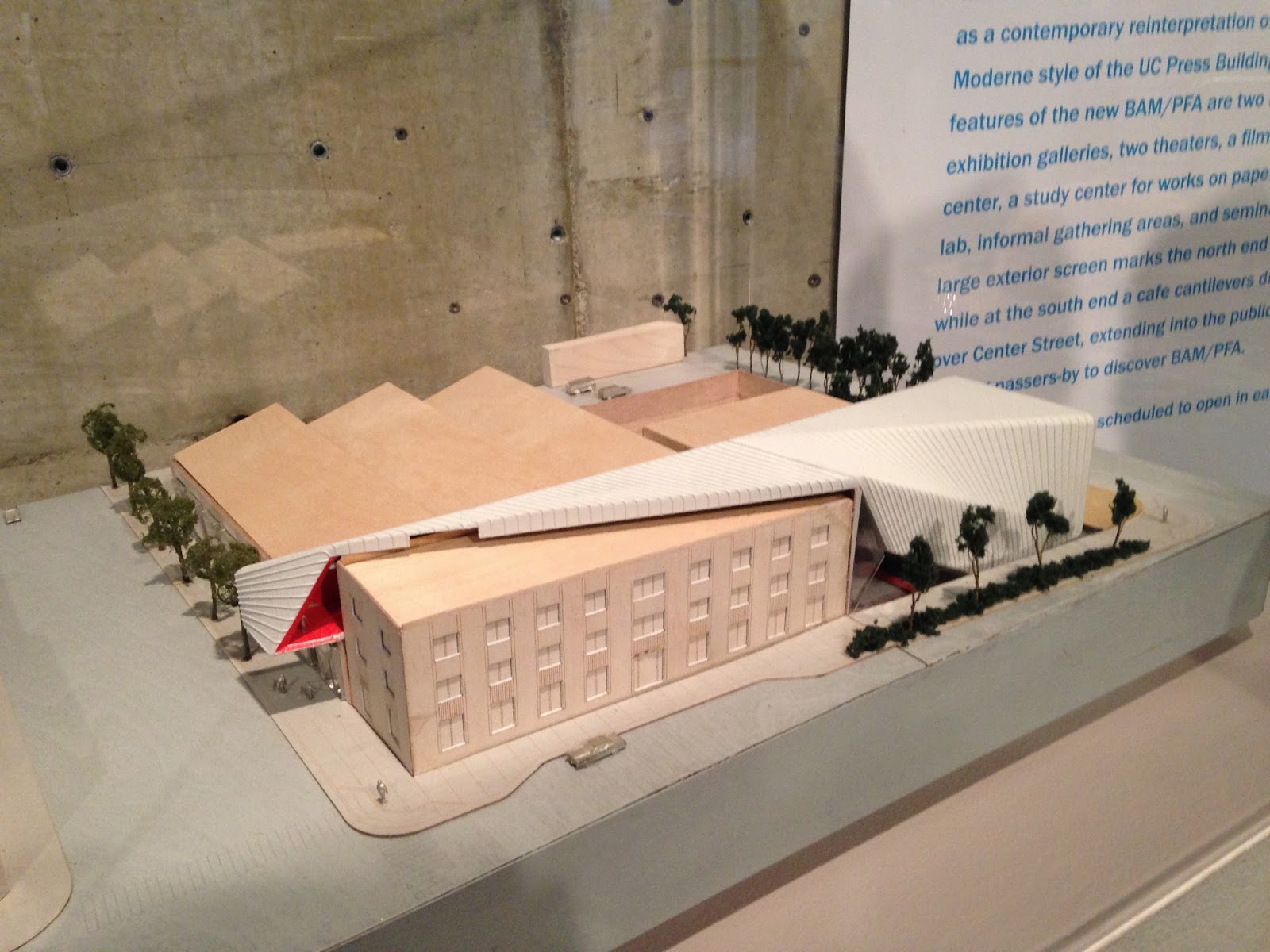
New model of Berkeley Art Museum
by Diller Scofidio + Renfro

Sunday, December 21, 2014, was last call for the Berkeley Art Museum. The fan-shaped concrete structure swept this boy off the street and held him for a long time. Mario Ciampi’s building from 1970 was full of surprises for a 12-year-old and still offers delight for the 56-year-old. Stairways, ramps, elevators, light, and concrete provided an excellent background for art that was confounding, challenging, and inspiring.

Bancroft Avenue elevation

Our parents were not especially adventuresome, but they did take us to New York, DC, and Montreal in 1967. The visual wonders of that trip have stayed with me forever. And a few years later, they took us to the new museum in Berkeley, where we saw Claes Oldenburg’s melting plugs and soft food. My parents were measured in their comments, not wanting to influence us one way or another. Having seen the Guggenheim’s fantastic spiral on our trip a few summers before prepared us for a building that was all about space and light. Some of the art we saw back east also got us ready to see everyday objects anew, but maybe didn’t prepare us for pop art that was so soft, so sensual, so real.


A few Hans Hofmanns
http://www.bampfa.berkeley.edu/exhibition/hofmannbyhofmann

A few years later, in high school, I made dozens of visits with friends to the museum (it was free for students!) and spent a lot of time with the Hans Hofmann paintings, which were then in the top floor gallery. I hadn’t read about his ideas about push and pull and planes, but I was overwhelmed by the sharpness of his colors. One piece, just one shade of flesh pink, was easier to look at because his exploration was so much simpler for my developing aesthetic. It was here that I saw my first works by Helen Frankenthaler, Mark Rothko, and Sam Francis. All lessons in color, space, and meditation.

The Berkeley Art Museum took risks and filled in gaps. Some shows, like the Juan Gris exhibit, were traditional in their presentation but gave me a whole chapter beyond Picasso and Braque that I had missed. Other shows used the building’s architecture to great effect, like Robert Irwin’s light sculpture in 1979. More recently, in 2012, the Barry McGee show filled the center with graffitied vehicles and a clubhouse. Most of the visitors I observed were asking what all this junk was doing in a museum. For the Kurt Schwitters show, the museum reconstructed Merzbau, a fantastic environment that existed in the artist’s flat in Hanover. http://designfaith.blogspot.com/2011/09/art-mind-kurt-schwitters-and-create-at.html

Pals Yosh Asato, David Baker, and Bruce Damonte

In the middle of the 1990 culture wars, Lawrence Rinder (then curator, now director) put on “In a Different Light.” It was not a show of gay artists exactly, but a show of gay sensibility organized around the themes of Void, Self, Drag, Other, Couple, Family, Orgy, World, and Utopia. Established artists and works from the collection were included along with emerging artists. It was a bold and brave step for a young curator. http://www.bampfa.berkeley.edu/exhibition/InaDifferentLight

Perhaps my favorite show was the Joe Brainard retrospective in 2001. He was inspired by both Schwitters and Gris. And he was fearless. His small, careful collages were controlled yet often erotic, while some of his sculptures, most famously his Prell extravaganza, seemed to explode fully formed. He passed away from AIDS in 1994. He often gave his work away to friends. While he had a critical and mischievous eye, his work always seemed to hold a message of love.
http://www.bampfa.berkeley.edu/exhibition/brainard http://queersage.blogspot.com/2012/11/i-love-joe-brainard.html

Stephen De Staebler thrones and ottomans left out in the rain.
http://www.stephendestaebler.com/
I feel like this space was perfect for art spectacles. It was a gift that allowed you to see art and also see space, and sometimes the two seemed to merge. The university may keep the building, but given their prior clumsy attempts to mitigate its structural and water defects, their track record isn’t very good. I think that architect Mario Ciampi and founding director Peter Selz gave the university a building that was larger than its institution.

Wednesday, September 7, 2011

Art Mind: Kurt Schwitters and "Create" at the Berkeley Art Museum

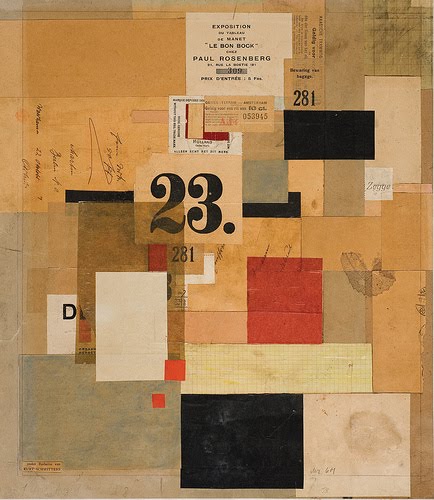
Kurt Schwitters: Mz 601, 1923; paint and paper on cardboard; 17 × 15 in.;
Sprengel Museum, Hannover, loan from Kurt and Ernst Schwitters Stiftung.
© 2011 Artists Rights Society (ARS), New York / VG Bild-Kunst, Bonn.

My favorite art shows remind me of an open mind, a mind that is, at least for a time, not distracted by finances, traffic, children, and what author Walker Percy called "everydayness." A mind apart, completely focused on expression, on arranging or rearranging a small part of the universe. Some might call it a child’s mind. It is the purity of childhood combined with a lifetime of seeing.

The other night, I went to an opening at Creative Growth, an art center for the developmentally disabled a few blocks from our home in Oakland. Architect Anne Fougeron has guest curated a show called "Opposition/Composition." Most of the pieces had an architectural angle, but only as an organizing principle. Most of the pieces felt fresh, the result of an open mind at work.

Artist: Natascha Haehlen
Sculpture at the Opposition/Composition show
at Creative Growth curated by Anne Fougeron

Over the weekend, I went to see the Kurt Schwitters show at the Berkeley Art Museum and found that there was a concurrent show, "Create," with art from Creative Growth and two other similar art centers, Creativity Explored in San Francisco and the NIAD Art Center in Richmond. Mounting both shows simultaneously makes this small museum exciting. On the one hand, "Create" explicitly shows what are often referred to as outsider artists. Schwitters is now part of the canon, but he was also an outsider for most his life.

Kurt Schwitters: Untitled (okolade), 1926;
collage of cut printed, and marbleized papers on paperboard;
image: 3 7/8 x 2 7/8 in.;
the Menil Collection, Houston.
Photo: Janet Woodard, Houston.

Kurt Schwitters MERZ 1926,3. Cicero, 1926;
paint on wood nailed on wood; 26-7/8 x 19-5/8 x 3-1/8 in.;
Sammlung NORD/LB in der Niedersächsischen Sparkassenstiftung,
Sprengel Museum Hannover
Photo: Michael Herling / Aline Gwose,
Sprengel Museum Hannover © ARS New York.

Kurt Schwitters: Untitled (Silvery), 1939;
collage, silver paint and cardboard on paper on transparent paper;
7 7/8 x 6 1/8 in.;
Kurt und Ernst Schwitters Stiftung, Hannover.
Photo courtesy: Kurt Schwitters Archives at the Sprengel Museum Hannover.
Photographers: Michael Herling / Aline Gwose,
Sprengel Museum Hannover © ARS, New York

Although the structure of the Berkeley Art Museum has been compromised by necessary seismic interventions, it remains one of my favorite modern buildings in the Bay Area. It opened as I entered middle school, and I visited a number of times throughout the 1970s. The whole family took a rare outing together to see the Claes Oldenburg show in 1971, which opened my eyes to what modern art might be. (Melting electric plugs!) For several years, a few of us from high school made almost weekly trips to see the baffling Hans Hoffman canvases on the top floor. The gentle ascent on ramps between galleries allows the viewer to slow down, focus on art, and then reconnect with the shared space occupied by other viewers. You can also take the elevator to the top and work your way down. This is a perfect way to move between the Schwitters show and the "Create" artists to see if they create a dialog. Both shows are both up for a few more weeks.

Installation view of Create, curated by Lawrence Rinder with Matthew Higgs.
On view at the Berkeley Art Museum and Pacific Film Archive (BAM/PFA)
from May 11 through September 25, 2011.
Photo: Sibila Savage.

Berkeley Art Museum

Schwitters lived from 1887 to 1948. He enjoyed some recognition and success in his career in Germany in the era following World War I. However, after Hitler’s rise to power in 1933, Schwitters was ostracized and shown only in exhibitions of deviant art. Eventually he moved to Norway and later England, but was unable to rebuild his famous three-dimensional Merzbau or coalesce a movement around his ideas.

The artists participating in "Create" are mostly working at the beginning of this century and are considered outsiders because of their disabilities. Despite the decades separating Schwitters and these local artists, there are many commonalities. In some pieces, it is the juxtaposition of found objects or the surprising combinations of color and words or letters; in others, it is the apparent randomness that results in a balance just short of chaos. But all of the pieces show the unconscious at work. That moment when deliberation or intent gives way to pure action, pure joy—that moment when time is lost. I think this is what art philanthropist Dominique de Menil was after in her many curatorial projects. A hint of the divine. No surprise that the Schwitters show was organized by the Menil Collection.

Lance Rivers: Richmond San Rafael Bridge, 2010;
ink and ballpoint pen on wood; 8 5/16 x 14 1/2 in.;
courtesy of the artist and Creativity Explored, San Francisco.

Mary Belknap: Untitled, 2006;
acrylic on fabric; 27 3⁄4 × 16 1⁄2 in.;
courtesy of the artist and Creativity Explored, San Francisco.

James Montgomery: Untitled, 2007;
correction fluid pen, ink, and acrylic on paper; 22 × 29 1⁄2 in.;
courtesy of Creativity Explored, San Francisco.

Rarely do two shows speak to each other this well about unconscious motivations without trying to make literal connections. While it may be unlikely that many of the artists in "Create" know about Schwitters, they evidence a similar desire to make order.

In the lowest gallery is the most ambitious aspect of the Schwitters show, a rebuilding of his much loved (and forever lost) Merzbau, a three-dimensional collage environment that existed in Schwitters’ Hanover flat. (It was destroyed by Allied bombers in 1943.) It has been reconstructed from historic photographs. Not every piece is there, but the essence of the room envelops a few people at a time and transports them. Wandering through the space, I kept thinking this space was timeless. All of the artists are part of one great all-encompassing art mind.

Peter Bissegger: Reconstruction of Kurt Schwitters's Merzbau,
1981-83 (original ca. 1930-37, destroyed 1943);
154-3/4 x 228 3/8 x 181 in.;
Sprengel Museum Hannover.
Photo: Michael Herling / Aline Gwose,
Sprengel Museum Hannover (c) Peter Bisseger.

For more information:
http://en.wikipedia.org/wiki/Kurt_Schwitters
www.menil.org
www.creativityexplored.org
www.creativegrowth.org
http://niadart.org/
http://www.bampfa.berkeley.edu/