A New Online Home for Design Faith Blog

I have moved the Design Faith blog to my relaunched website kennethcaldwell.com You'll be redirected there in 10 seconds.

Showing posts with label Dominique de Menil. Show all posts

Monday, September 9, 2013

Postcard from Houston


Everybody maligns Houston. I like it. But then, I like Los Angeles, too. Houston reminds me a lot of Los Angeles, but with more humidity, more parking, and slightly less traffic. It is much easier to navigate. Basically everything that you are interested in is inside the Interstate 610 loop. So while the city sprawls outward forever, most of the good stuff is within a relatively small circle—unlike Los Angeles.

First, let’s talk about the town of no zoning. This means high-rises next to mansions, laundries across the street from a Dan Flavin installation, dance halls next to middle-class residential districts. Apparently, there are codes on how property can be subdivided, but the voters have turned down zoning repeatedly. Not an experiment worth repeating, perhaps, but it does create some bizarre adjacencies.

The laundry across the street from the Menil Flavin installation.


Museum of Fine Arts - wing by Mies van der Rohe

Quaker meeting house with skyspace by James Turrell


Reyner Banham reintroduced Californians to Los Angeles and got people to see it with fresh eyes. Architect Carlos Jiménez did that for Houston. I heard him lecture a long time ago. He asks you to look at the sky, at the possibilities of a new city.

The Houstonian Hotel is one of those buildings where the architecture is irrelevant and the décor is everything. I call it “we are rich now” décor. Some of the fabrics and details are lovely, but the overall effect is sort of Hearst Castle for the parvenu. But that doesn’t mean it’s not fun! In Houston, like Los Angeles, you just add water and you have a jungle. Nobody remembers that the Houstonian is actually a banal, modern, office park-like structure, but rather that all the rooms look out onto dense foliage. It’s like staying in a baroque terrarium!


Houstonian lobby


Houstonian pool and jungle


Driving around Houston, we did smell gas occasionally. This is a town built on oil. Even the parts that I am drawn to—the art and architecture that arrived with the largesse of the de Menil family—came about because of oil. The Schlumberger oil drilling fortune paid for the Rothkos, Philip Johnson, and Walter De Maria. The most challenging and spiritual of good works are rooted in Texas gold.

Driving is a divine right in Texas, and nobody bothers with a Prius. It’s all about big fortress cars being aggressive on the freeways. We had a few near-accidents. Some of this is to due to the confusion of the lane markers and last-second lane changes. But when you are sitting by the pool, these folks couldn’t be nicer, and everybody wants to help you find a good restaurant. Foodie culture has definitely come to Houston. Two places that we tried and enjoyed were Hugo’s, which offers haute Mexican cuisine, and Triniti, which would have fit right into any affluent coastal city in California.

Our purpose in visiting Houston was to see the James Turrell exhibit at the Museum of Fine Arts. (More on that in a later post.) We nearly missed an exquisite show at the Menil Collection entitled Byzantine Things in the World, which links various pieces in the Menil Collection over history. Although I still struggle with Cy Twombly’s work, the lighting (only natural light when we visited) in the Twombly Gallery at the Menil is simply stunning in its subtlety. That little building is one of Renzo Piano’s great accomplishments in lighting. If only he had done the Rothko Chapel! We were also lucky enough to stumble on Soo Sunny Park’s sculpture at the Rice Gallery. Although made of chain link fence and Plexiglas, the sculptures seem to float and change shape before your eyes.

Rothko Chapel with sculpture
by Barnett Newman (gift of the de Menils)

 Soo Sunny Park’s exhibit at Rice University


Another architectural highlight was tracking down the de Menil’s home (designed by Philip Johnson in 1950) on San Felipe Drive. There are no sidewalks on that section of the busy street so you have to park on a side street and walk on along a verge and cross the street and peek down the drive. Johnson fought with Mrs. de Menil over the windows on the right side of the front elevation. She won. He hated them. But he really hated the interiors by her Charles James, her fashion designer. Now they are legendary. James knew that Johnson needed to be softened up several decades before he realized it. Unfortunately, the public can’t visit the house but it is owned by the Menil Foundation and completed a extensive restoration about ten years ago. By the time we returned to where we had parked, two cars from the River Oaks Patrol were on us. The ruling class don’t screw around. I doubt the security folks get many people telling them they are architectural writers checking out significant landmarks. Because from what we could see River Oaks doesn’t have very many!

Typical River Oaks residence

de Menil residence in River Oaks


For more information:

http://www.carlosjimenezstudio.com/
http://www.menil.org/
http://www.ricegallery.org/new/exhibition/unwovenlight.html
http://www.rothkochapel.org/
http://www.nytimes.com/2004/06/03/garden/a-house-that-rattled-texas-windows.html?pagewanted=all&src=pm

Friday, May 11, 2012

Finding the Right Architect

Some Notes on the Rothko Chapel
John and Dominique de Menil, 1968.
Photo: Hickey-Robertson, Houston
courtesy menil.org

If there was one person who inspired me to begin this blog, it would be Dominique de Menil. (I never met her.) She was born in France, but spent much of her adult life in the United States exploring the terrain where art and faith cross. She was patrician, educated, thoughtful, and generous. A biography by William Middleton is slated to be published next year. In the meantime, there are books about her and several art books to which she contributed essays. I think of her often and wrote about her recently for a brief piece in Faith & Form (http://www.faithnform.com/). The editor, Michael Crosbie, posed a question on his LinkedIn site: “Can atheists design sacred spaces?” And that got me thinking about all kinds of folks, including Dominique de Menil, Mark Rothko, and Philip Johnson. In my short piece, I didn’t have enough room to really get into Johnson. That’s what a blog is for!

In her largesse, Mrs. de Menil commissioned a number of architectural projects. For the Menil Collection in Houston, she eventually turned to a young Renzo Piano, who created a masterwork that helped launch his career in the United States. It remains one of my favorite museums in this country. It looks simple, like some of the art contained within, but like the art, it’s not. She scored a home run with that one. Piano’s courtliness and humility were genuine. It’s in the work.

Museum Building
courtesy menil.org

Cy Twombly Gallery
courtesy menil.org

Earlier in her philanthropy, de Menil commissioned several works from Philip Johnson. In this effort, the results were mixed. The campus for the University of St. Thomas, a small Catholic university in Houston, is a serene academic environment where the student outdid the master: it’s better, though considerably smaller, than Mies van der Rohe’s IIT campus in Chicago. The brick has a rose tint that works in the Houston light. Here you can tell the difference between an industrial building and a chapel. But the chapel, built later during Johnson’s postmodern phase, just doesn’t fit. It’s in the right location, but it feels tacked on, and like most of his work during this era, looks a bit comical.

His first project for the de Menils, their residence in Houston’s River Oaks neighborhood, was so austere that most folks thought it was an industrial building. And the flat roof leaked. Apparently Mrs. de Menil insisted on the windows in the kitchen, so the façade is not as austere as Mr. Johnson wanted. She also didn’t go for a house furnished with a few pieces of perfect Miesian furniture, and so she hired her dress designer, Charles James, to help decorate. And he did what Johnson couldn’t do— humanize it. His soft, sensuous furniture and unusual color palette provided the right background for the de Menils’ life. Mix it up. Johnson hated it and wouldn’t include the house in monographs.

Philip Johnson

Menil House, ca. 1964
courtesy menil.org

Menil neighborhood
courtesy menil.org

The de Menils’ least successful collaboration with Johnson (if collaboration is the word) was to commission him for the Rothko Chapel. At first this was to be part of the St. Thomas campus, but that changed over time, and it became a nondenominational chapel a few blocks away.

Johnson spent his career focusing on wealth and power. He knew how to ingratiate and how to imitate. He could follow the money, but he didn’t really have an original idea. His other ecclesiastical projects, like the Crystal Cathedral, aren’t inspiring. With the de Menils and Rothko, he had a client and an artist who exemplified the idea of art as transcendence. But that meant he wouldn’t be the star. His limitation was his endless sense of self.

There was a precedent for Rothko and Johnson collaborating, and it did not go well. The recent play “Red” is built around Rothko’s turmoil painting a set of murals for the Four Seasons, the restaurant that Johnson designed at the base of the Seagram Building (the office tower on Park Avenue that Johnson designed with Mies van der Rohe). The legend is that after dining in the restaurant, Rothko was so disgusted by the wealthy patrons that he returned the commission. (The paintings are now in the Tate Modern in London.)

For years, the paintings in the Rothko Chapel have been plagued by the lighting conditions and their inadequate solutions. As others have noted, Rothko probably did not understand the light conditions of Texas. But the problem was deeper than that. Johnson didn’t understand Rothko as an artist. Johnson was a chameleon of great skill, but one would be hard pressed to suggest that he was a spiritual man.

Barnett Newman's Broken Obelisk and the Rothko Chapel
photo: Frances Carter Stephens
courtesy rothkochapel.org

Rothko Chapel interior
photo: Hickey-Robertson
courtesy rothkochapel.org


Philip Johnson never fully lived down his well-documented Nazi sympathies, but went so far as to atone for his sins by designing a temple on Long Island and a nuclear reactor for Israel. But as another writer once pointed out, he got the symbols mixed up: the temple looks like a reactor and the reactor looks like a temple. I would rarely find myself in agreement with the late conservative art critic Hilton Kramer, but his article assessing Johnson’s career in a 1995 issue of Commentary hits the mark.

“—what characterizes his work is a series of brilliantly performed charades in which other people’s ideas, other people’s tastes, and other people’s styles have been appropriated, exploited, deconstructed, and repackaged to advance the prosperity of his own reputation and influence.”

Johnson was an amoral man. He didn’t stand for much beside himself. It’s well known that Rothko was often difficult and paranoid. But he was painting for something beyond himself. Houston architects Eugene Aubry and Howard Barnstone finished the Rothko Chapel after Johnson left the commission, although he was invited back later to consult on the entry.

Could another architect with a greater spiritual sensitivity have given Rothko a space equal to his work? It is a shame that the de Menils did not commission Louis Kahn for this project. He didn’t have the social airs and the wealth that Johnson did. His office wasn’t filled with expensive flowers and furniture. But he was known to them. He had written an introduction to an exhibition Mrs. de Menil organized at St. Thomas in 1967. Wouldn’t his poetic ideas about space, light, and silence have found resonance with the de Menils? Indeed, he did do some initial schemes for the Menil Collection building, but both he and Mr. de Menil died in the early 1970s.

In his biography of Rothko, James E. B. Breslin writes that the viewer cannot see the complete work in the chapel simultaneously and concludes that the murals “…are spiritual only in the sense that they renounce the world.…” My own experience was that the withdrawal, like a retreat or meditation, allows the individual to return to the outside world more present and more compassionate. It took a religious client and an agnostic artist with a great capacity for the transcendent to create that space. Too bad the original architect was so rooted in his earthly self.

Dominique de Menil with various Religious Leaders
Dedication of the Rothko Chapel, 26-27 February 1971
courtesy rothkochapel.org


Further readings
http://www.commentarymagazine.com/article/philip-johnsons-brilliant-career/

http://richardwiseman.wordpress.com/2012/01/31/blog-special-alain-de-botton-on-his-temple-of-atheism/

http://www.amazon.com/Art-Activism-Projects-Dominique-Collection/dp/0300123779

http://www.amazon.com/Sacred-Modern-Activism-Aesthetics-Collection/dp/0292723334/ref=sr_1_4?s=books&ie=UTF8&qid=1336523162&sr=1-4

http://www.amazon.com/The-Rothko-Chapel-Writings-Threshold/dp/0300167776/ref=sr_1_2?s=books&ie=UTF8&qid=1336523194&sr=1-2

http://www.amazon.com/The-Rothko-Chapel-Act-Faith/dp/0945472005/ref=sr_1_3?s=books&ie=UTF8&qid=1336523217&sr=1-3

http://www.amazon.com/The-Rothko-Chapel-Paintings-Structure/dp/0939594374/ref=sr_1_1?s=books&ie=UTF8&qid=1336523236&sr=1-1

Wednesday, September 7, 2011

Art Mind: Kurt Schwitters and "Create" at the Berkeley Art Museum

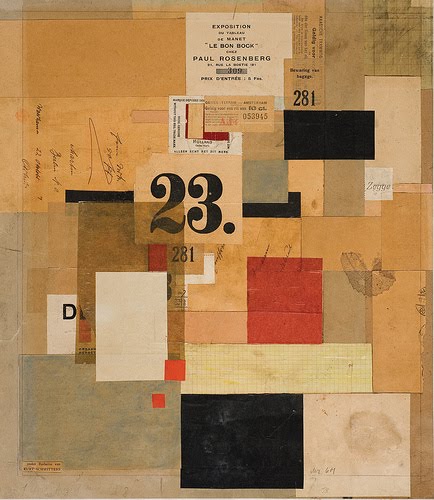
Kurt Schwitters: Mz 601, 1923; paint and paper on cardboard; 17 × 15 in.;
Sprengel Museum, Hannover, loan from Kurt and Ernst Schwitters Stiftung.
© 2011 Artists Rights Society (ARS), New York / VG Bild-Kunst, Bonn.

My favorite art shows remind me of an open mind, a mind that is, at least for a time, not distracted by finances, traffic, children, and what author Walker Percy called "everydayness." A mind apart, completely focused on expression, on arranging or rearranging a small part of the universe. Some might call it a child’s mind. It is the purity of childhood combined with a lifetime of seeing.

The other night, I went to an opening at Creative Growth, an art center for the developmentally disabled a few blocks from our home in Oakland. Architect Anne Fougeron has guest curated a show called "Opposition/Composition." Most of the pieces had an architectural angle, but only as an organizing principle. Most of the pieces felt fresh, the result of an open mind at work.

Artist: Natascha Haehlen
Sculpture at the Opposition/Composition show
at Creative Growth curated by Anne Fougeron

Over the weekend, I went to see the Kurt Schwitters show at the Berkeley Art Museum and found that there was a concurrent show, "Create," with art from Creative Growth and two other similar art centers, Creativity Explored in San Francisco and the NIAD Art Center in Richmond. Mounting both shows simultaneously makes this small museum exciting. On the one hand, "Create" explicitly shows what are often referred to as outsider artists. Schwitters is now part of the canon, but he was also an outsider for most his life.

Kurt Schwitters: Untitled (okolade), 1926;
collage of cut printed, and marbleized papers on paperboard;
image: 3 7/8 x 2 7/8 in.;
the Menil Collection, Houston.
Photo: Janet Woodard, Houston.

Kurt Schwitters MERZ 1926,3. Cicero, 1926;
paint on wood nailed on wood; 26-7/8 x 19-5/8 x 3-1/8 in.;
Sammlung NORD/LB in der Niedersächsischen Sparkassenstiftung,
Sprengel Museum Hannover
Photo: Michael Herling / Aline Gwose,
Sprengel Museum Hannover © ARS New York.

Kurt Schwitters: Untitled (Silvery), 1939;
collage, silver paint and cardboard on paper on transparent paper;
7 7/8 x 6 1/8 in.;
Kurt und Ernst Schwitters Stiftung, Hannover.
Photo courtesy: Kurt Schwitters Archives at the Sprengel Museum Hannover.
Photographers: Michael Herling / Aline Gwose,
Sprengel Museum Hannover © ARS, New York

Although the structure of the Berkeley Art Museum has been compromised by necessary seismic interventions, it remains one of my favorite modern buildings in the Bay Area. It opened as I entered middle school, and I visited a number of times throughout the 1970s. The whole family took a rare outing together to see the Claes Oldenburg show in 1971, which opened my eyes to what modern art might be. (Melting electric plugs!) For several years, a few of us from high school made almost weekly trips to see the baffling Hans Hoffman canvases on the top floor. The gentle ascent on ramps between galleries allows the viewer to slow down, focus on art, and then reconnect with the shared space occupied by other viewers. You can also take the elevator to the top and work your way down. This is a perfect way to move between the Schwitters show and the "Create" artists to see if they create a dialog. Both shows are both up for a few more weeks.

Installation view of Create, curated by Lawrence Rinder with Matthew Higgs.
On view at the Berkeley Art Museum and Pacific Film Archive (BAM/PFA)
from May 11 through September 25, 2011.
Photo: Sibila Savage.

Berkeley Art Museum

Schwitters lived from 1887 to 1948. He enjoyed some recognition and success in his career in Germany in the era following World War I. However, after Hitler’s rise to power in 1933, Schwitters was ostracized and shown only in exhibitions of deviant art. Eventually he moved to Norway and later England, but was unable to rebuild his famous three-dimensional Merzbau or coalesce a movement around his ideas.

The artists participating in "Create" are mostly working at the beginning of this century and are considered outsiders because of their disabilities. Despite the decades separating Schwitters and these local artists, there are many commonalities. In some pieces, it is the juxtaposition of found objects or the surprising combinations of color and words or letters; in others, it is the apparent randomness that results in a balance just short of chaos. But all of the pieces show the unconscious at work. That moment when deliberation or intent gives way to pure action, pure joy—that moment when time is lost. I think this is what art philanthropist Dominique de Menil was after in her many curatorial projects. A hint of the divine. No surprise that the Schwitters show was organized by the Menil Collection.

Lance Rivers: Richmond San Rafael Bridge, 2010;
ink and ballpoint pen on wood; 8 5/16 x 14 1/2 in.;
courtesy of the artist and Creativity Explored, San Francisco.

Mary Belknap: Untitled, 2006;
acrylic on fabric; 27 3⁄4 × 16 1⁄2 in.;
courtesy of the artist and Creativity Explored, San Francisco.

James Montgomery: Untitled, 2007;
correction fluid pen, ink, and acrylic on paper; 22 × 29 1⁄2 in.;
courtesy of Creativity Explored, San Francisco.

Rarely do two shows speak to each other this well about unconscious motivations without trying to make literal connections. While it may be unlikely that many of the artists in "Create" know about Schwitters, they evidence a similar desire to make order.

In the lowest gallery is the most ambitious aspect of the Schwitters show, a rebuilding of his much loved (and forever lost) Merzbau, a three-dimensional collage environment that existed in Schwitters’ Hanover flat. (It was destroyed by Allied bombers in 1943.) It has been reconstructed from historic photographs. Not every piece is there, but the essence of the room envelops a few people at a time and transports them. Wandering through the space, I kept thinking this space was timeless. All of the artists are part of one great all-encompassing art mind.

Peter Bissegger: Reconstruction of Kurt Schwitters's Merzbau,
1981-83 (original ca. 1930-37, destroyed 1943);
154-3/4 x 228 3/8 x 181 in.;
Sprengel Museum Hannover.
Photo: Michael Herling / Aline Gwose,
Sprengel Museum Hannover (c) Peter Bisseger.

For more information:
http://en.wikipedia.org/wiki/Kurt_Schwitters
www.menil.org
www.creativityexplored.org
www.creativegrowth.org
http://niadart.org/
http://www.bampfa.berkeley.edu/