A New Online Home for Design Faith Blog

I have moved the Design Faith blog to my relaunched website kennethcaldwell.com You'll be redirected there in 10 seconds.

Thursday, October 27, 2011

Postcard from Oakland


This morning the helicopters stopped hovering. Frank Ogawa/Oscar Grant/Occupy Oakland Plaza in front of City Hall was mostly empty. A few tents, maybe a dozen people meeting, a few dozen milling about. No fences that I could see. A woman handed out donuts to whoever wanted them. The aroma of strong marijuana filled one corner. There were more television cameras than cops. No windows broken, no trash, just city folks fixing a water pipe. This was the epicenter of a riot that made international news?


Some have criticized the larger Occupy Wall Street movement for not having a clear message. I think this is one of its beauties. As with an abstract canvas, you can see what you need to see. Like the early abstractionists, the protestors share an overarching vision: the current regime won’t last. And I don’t mean Obama. I am talking about a society that puts money ahead of human beings.

Occupy Wall Street and its sister occupations are really about something quite simple, if global. We have to stop seeing money as God. It’s just another bead, another system of trading. It has no intrinsic value. Like any system of trade, the tool is only worth what we perceive it to be. The larger truth is that human life (after birth, in case you were wondering) is what matters here. It comes first. The Occupy movement exists to stop the world from spinning around a money axis and get it spinning around a human axis.

One day, corporations will ask if a decision is best for the communities they SERVE, not for the quarterly returns. By the way, “publically held corporation” is a misnomer. It is a way for the one percent to take advantage of the resources of the 99 percent. All of us need to ask, whom are we serving? How is our work of service? Not whether we make maximum profits or have enough to look richer than our brethren.


It is easy to walk around the Occupy SF or Oakland camps and see mostly homeless folks. Admittedly, some of them don’t seem mentally balanced. Some of them smell. But they are the foot soldiers of this chapter of an evolving revolution. At night, after we protest with them (and then go shopping at Whole Foods before going home to our comfy nests), they sleep on benches or, for a few weeks, in tents in front of City Hall. I admit that I am not inclined to engage with them personally, but I am no longer afraid to walk among them. And they may be leading us to a promised land where people come before profits.

Our prayers go out to Scott Olsen, a veteran who served two tours of duty in Iraq and was injured by a police projectile Tuesday night. Today his condition was upgraded to fair.

Monday, October 24, 2011

Jeremy Mende Interview


Visual artist and designer Jeremy Mende recently returned from spending eight months as a fellow in design at the American Academy in Rome. His project “100 Years from Now” was launched on February 20, 2011, to coincide with the 102nd anniversary of the publication of the original Italian Futurist manifesto. English signs with five phrases were installed in four neighborhoods in Rome, provoking readers to think about their anxious future. The five phrases were:

the clock
to be a machine
despite the denials
100 years from now
a kind of panic

A website (www.100yearsfromnow.info) is part of the project. One of the comments a visitor to the site left a week ago was, “I’ll be dead in a 100 years (hopefully).”

We caught up with Jeremy on his return to find out what he was up to.

Q: What was the essence of the idea you took to the American Academy?

Jeremy Mende: We live in a time where we’re inundated with information that shows how contemporary society is exhausting our resources – peak oil, climate change, extreme water shortages, the population explosion – and yet we seem to be unable to generate any real momentum for societal change. These crises remind us that our global system has limits, yet our lifestyle is based on the assumption of no limits. I think this paradox is generating a growing sense of anxiety about a future that will likely be determined by forces beyond our control. Unlike the Italian Futurists who demonstrated an overwhelming confidence in their vision, our is an uncertain look into the future – a kind of anxious futurism.

The project in Rome was an attempt to capture a sense of this anxiety; to ask the question what is it like to live in a time where critical change is necessary but potentially impossible.

Q: Why is it called “100 Years from Now?”

Mende: It’s impossible to read the phrase and not generate at least a partial vision of the future. At the same time that vision is beyond the reach of any one lifetime so I found that incongruity compelling.


Q: Why the intense interest in the Italian Futurists?

Mende: The values the Futurists celebrated—speed, ego, technology, industrialization, power—still somehow define us. We have a much more ambivalent sense of these things but we are, in many ways, living in a version of the world the Futurist’s dreamed of.

Q: What was your process when you got to the American Academy? What were you doing in that huge studio?

Mende: The work was really a search for a viable visual language. I created a number of form and content studies however it bothered me that as a designer I had no clear context for the work I was making. If I saw what I was doing as “design” there was no client to make use of it, and if I saw what I was doing as “art” there was no gallery to show it.

This ambivalence lead me to look outside the studio for inspiration. In Rome messages on the street are everywhere: inscriptions, signage, advertising, graffiti. It is probably the most written on city in Europe. I began to pay close attention to street advertising and how people interacted with it. I became interested in the possibility of hacking this system. Once I decided the street would be the site many of the other decisions fell into place.

Q: Did any of the people that you met influence the direction of the project?

Mende: The biggest influence came from interacting with writers and poets. The project is really based on the idea of creating poetic fragments that provoke personal interpretation – very, very short poems that refuse to resolve themselves.

Q: When did the idea begin to coalesce?

Mende: The Futurists identified the idea of ambientazione emotiva – that certain forms of visible language, concrete poetry for instance, compel the reader to perform the poem and thereby create a powerful personal space of interpretation. They believed that this type of individual signification happens organically, working on us before the more ‘mechanical’ processes of traditional reading. 100 Years From Now was an attempt to orchestrate a contemporary ambientazione emotiva on the scale of the city.


Q: Did you have dozens of phrases and edit them down to these five?

Mende: Yes, I wrote hundreds of phrases. I was looking for a finite set that would underscore the cultural tensions that I think produce this sense of anxiety. Roughly speaking:

time and time limits
the ever-narrowing space between human and machine
the impossibility of truth in an over-mediated world
visions of the future
a growing undercurrent of anxiety

Q: What is the relationship between the five questions posed on the website and the five statements on the posters?

Mende: The five questions on the site were a way to focus the ambiguous nature of the phrases on the street. For those motivated enough to go to the site I wanted to reward them with a more literal way to get at the bigger ideas that drove the project. For each phrase the site presents a question that adds context.

I was, however, concerned about putting a URL on the signs. It was very important that the signs be as blank as possible. To avoid the need for a URL the individual phrases were tagged in AdWords, Google’s online advertising platform, so that users performing online searches would find announcements for the project in the form of online ads. These ads created an immediate way for users to link directly to the website.


Q: Was this a graffiti kind of project? You just put them up at random spots around Rome? Or was there a map of Rome?

Mende: The installation was highly planned. I worked with the municipality of Rome to produce the project in the four most youth-oriented districts of Rome—Trastevere, Testaccio, Pigneto, and San Lorenzo. These zones have a high concentration of politically engaged, English-speaking, technologically aware people. The municipality supported the project with a cultural grant which allowed me access to a large amount of media space – 1000 placements for 30 days.

Q: Did you go out and observe people’s reactions?

Mende: Yes. The project launched on February 20th – the anniversary of the original 1909 Futurist Manifesto – and ran for 30 days. When the signs first appeared on the street people would do double-takes, and then approach them looking for more information. After the first week the Roman cultural blogs lit up with images and related interpretations of “Il bianchi manifesti” (the white posters), as they came to be called by media. Flickr and Facebook pages were populated with images of the signs and grafittied responses began to appear on the posters themselves. The interpretations on the blogs ran the gamut but in general people read the blank tone as both existential and political; that as much as the issues presuppose an oppositions between the engaged vs. the disengaged, people understood we are simultaneously part of both groups.

In terms of numbers the site recorded 19,000 hits and over 700 comments in 30 days. And as much as there was variety in the responses, three themes came up repeadtedly: a nagging fear that our technological development is coming at the cost of human values like intimacy, and authenticity; faith in the social consciousness of the individual but extreme skepticism as far as governments and commerce; and most disturbingly a sense that real change will only occur as the result of large-scale disaster. This fatalism was one of the larger conclusions – that we are accepting paralysis as a response to the magnitude and complexities of the global issues in front of us.


Q: Given that you are a designer known for striking visuals, why did you decide to use such a minimal graphic approach?

Mende: It was actually very hard to work so minimally. I looked at more formal approaches but these directed the resulting interpretations too much. They either pushed the project into the subjective territory of street art or the commercial zone of advertising. Minimalism was a strategy to project the phrases as pure messages—semantic blocks hanging in space, demanding a reading but refusing to give much away.

Q: The project combines the Web and this old method of street poster. Can you comment on that?

Mende: Contemporary media and technology make it very easy to select what we want to see and what we don’t want to see. Producing the project in real space made it much more difficult to ignore. Multiple exposures worked to penetrate the cognitive firewall we have all learned to construct in order to protect us from messages we find uncomfortable, even if those messages are personally relevant.

Q: Is this project tilting over to art?

Mende: Yes, it is art.

Q: Do you know how this project or your time in Rome might influence your practice once you return to San Francisco?

Mende: I’m increasingly interested in the idea of public interventions. Creating opportunities for people to make positive, personal sense of issues that are determining our world – to realize that they have a vote in the creation ‘the now’– that is empowering, and essential if we want a participatory culture. San Francisco is not Rome and the opportunities for access to outdoor media are much more controlled here. We do, however, have far greater access to technology. I see a version of this project in SF but figuring out the actual/virtual interaction will be more challenging. Billboards are an obvious choice and their authority and monumentality appeal to me, but that will require partnerships that are more difficult to create. Rome proved that cultural, commercial, and civic partnerships can happen, but then they have a very long history of reconciling these interests. My hope is to use the Rome project as an example, and then to build partnerships that allow a more truly interactive version to be produced here.

For more information please visit Jeremy's website www.mendedesign.com.

Friday, October 21, 2011

The Rest of the News from Monterey

Asilomar Gateway

I wrote a blog for The Architect’s Newspaper about the Monterey Design Conference. They wanted it short and sweet. So I decided to post some of the long and sour here.

Although I attended almost all the programs, I struggled to find a theme. In some ways, it was a relief that the conference organizers didn’t impose one.

If architecture is going to survive, it needs both research and humility. To initiate research, often without payment, takes a lot of confidence. But confidence is rendered more believable when mixed with humility. The media machine, of which I am a card-carrying member, has put too much emphasis on fame and notoriety. Students entering architecture school think they have a chance of becoming famous. If you look at the numbers, I think they have a better chance of becoming a movie star.

I have a lot of regard for young architects who try to carve their own path without too much focus on fame. That was the case with most of the “Emerging Talent” sessions. Only one of them seemed to have been plucked from the magazines.

All four of the “Emerging Talent” sessions shared a theme of research. I am still wondering whether the robots of Andreas Froech (of Machineous) can make wall facades. But the mysterious wall at SFMOMA created by Andrew Kudless (of Matsys) changes depending where you stand. [both images] I also loved the straw exhibition building and simple graphics presented by the two partners of Rael San Fratello, even though I wasn’t quite sure what they were up to.

IDEO Fellow Liz Ogbu

Although some architects, like Minnesota’s David Salmela, have very modest practices, and others are growing their firms with international commissions, like Jeanne Gang, there was, for the most part, a refreshing humility. Salmela’s slides couldn’t be seen because of poor lighting, and he is not a sparkling lecturer, but his Midwest roots and sure hand were reminders that a very small practice can produce exquisite work. Very importantly, he read two poems as part of his presentation. For him, place is not just the physical locale where you work, but the emotional place your work emanates from. He reminded us that architects cannot live on design alone.

Jeanne Gang must have the reputation of being the kindest world-famous architect. Having won a MacArthur “genius grant” has not changed her style at all. The humble speakers are often the funniest too. Although she anchors her work in research, her academic explorations result in some powerful completed projects, like the famous Aqua tower in Chicago, where her firm employed topographic studies to create unexpected views from freeform balconies.

Dr. Dickson Despommier from Columbia, who spoke about Vertical Farms, looked like a well-rehearsed TED lecturer. But he seemed to follow an unspoken theme that all of us are feeling: “Where do we go now?” He claims that 80% of available land is already being farmed and that the runoff is destroying our rivers and oceans. His solution to the world’s food crisis is to create vertical indoor gardens. There were a lot of statistics presented in his well-paced presentation, but the audience didn’t seem convinced. Perhaps because he didn’t relate it to design?

Communications consultant Yosh Asato was very convincing about the possibilities of social media. She anchored the panel with a very concise and practical exploration of the possibilities, using real-world examples. Moderator (and frequent MDC attendee) Cliff Pearson, deputy editor of Architectural Record, told the group that the panel wanted to focus on the implications for practice, not marketing. Certainly there are several obvious uses in planning and public participation. But there is still scant evidence that social media impacts design. Although, as Asato pointed out, one housing developer and architect team did use it to test design options in the marketplace. Kelsey Campbell-Dollaghan, content director for Architizer, was clear that social media won’t create design, but may enable it.

Bill Leddy with Cliff Pearson

Tim Culvahouse and Sam Lubell at Gibson Beach

Maybe Los Angeles design star Michael Maltzan didn’t quite follow the “humble” theme, but his range of work, from San Francisco State University’s new performing arts complex to an interior-focused house next to an exposed Neutra house to his numerous and extremely varied projects for Skid Row Housing in LA, did delight the crowd. You could feel the audience perk up when he showed the glowing band shell in Playa Vista Park. Certainly this is one architect who is unafraid of the power of design, even if the project’s budget is very modest.

But the highlight of the show came on Sunday morning. Landscape architect Peter Walker’s presentation about the design process for the World Trade Memorial was beautifully organized, open, and moving. To accomplish such a simple and powerful design on such a contested and complex site required someone with a full, rich career behind him and all the wisdom and patience that brings. He is the only Monterey lecturer that I have ever seen receive a standing ovation.

One of the happy accidents of the conference was to pair Walker’s inspiring wisdom, the result of his long arc, with the inspiring optimism of Borja Ferrater, a young Spanish architect who studied biology in the US and practices with his father, sister, and brother-in-law in Barcelona (a real family affair). Over the years, one of the successes of the conference has been its ability to bring in international talent to shake things up. Ferrater is the son of the well-known architect Carlos Ferrater. When Borja joined the practice, it was reorganized into the Office of Architecture in Barcelona. Ferrater’s occasional mispronunciations did nothing to deter from the work; indeed it added to his humility and humor. He proudly presented the work of his father and was always careful to state whether he had been involved in a project or not.

The scale of housing ranged from camps for children with special needs to a mansion to Olympic housing to a botanical garden. He mentioned that his father often spoke of buildings working like machines. Borja said that their buildings are like Swiss watches, but not as boring. One his most important phrases was “optimistic engagement.” Ferrater is one those rare architects whose work and manner seemed indistinguishable, and that’s why he was so popular. Most of the attendees were looking for a reason to just feel better, to be optimistic. And this rigorous work, grounded in place and geometry, seemed to fill the bill.

The Asilomar setting remains beautiful, even though there were the usual grumblings about the poor quality of the food and the rising cost of the rooms, which are approaching resort prices for rudimentary accommodation and nonexistent service. The lack of enough meal tickets for attendees was just one of the many logistical oversights.

The Post Party overlooking Gibson Beach

Invariably, the technology at the awards program fails. Some say it is Julia Morgan’s ghost exacting revenge for so few women architects being recognized. This year’s event acknowledged some of state’s best architects, but the presentation was unbearably long. But these mishaps add to the comical DIY camp quality of the affair. Unfortunately, due to the relatively high cost of the event (and housing), there are too few young practitioners in attendance. A few folks told me that there are far cheaper rooms down the road and on Air BnB. This is something future conferences might address.

Jill Pilaroscia with the author just before the bust.

Perhaps the weirdest moment of the conference for me was when a staff member threatened one of the many drinking parties with arrest and fines. We all felt like teenagers again. While the for-profit operators don’t seem to understand the deep beauty of the place, the good news is that the Phoebe Hearst Social Hall is being renovated by Page & Turnbull with interiors by BraytonHughes Design Studio. Next time perhaps we will be able to gather in the original Julia Morgan tearoom without fear of prosecution. Nah, they will close too early. See you in two years!


Gibson Beach

Tuesday, October 18, 2011

The Foundation Maybe Kinda Funky


We had every intention of going to the San Francisco version of the Occupy Wall Street rally Saturday afternoon before going to dinner in the city. But we were waylaid by an extended weekend nap. Not wanting to miss the start of the revolution, I took BART downtown on Sunday to check out Occupy San Francisco. (This was before the police cleared away the tarps Sunday evening.) The protest continues in front of the Federal Reserve Bank. There were perhaps two dozen protestors and only three policemen. Over at the camp itself in the south end of Justin Herman Plaza, there were several more people mostly hanging out. The north end of the park is being turned into the holiday ice rink. Dividing these two sides is an avenue of craft merchants. Overhead a zip line whines and patrons fly like Tinkerbell.


At first sight, the encampment is not exactly welcoming. There are piles of clothes and sleeping bags. One man rakes the sand like a monk while another woman uses a large broom to brush away garbage. The site didn’t smell bad, but it wasn’t a Boy Scout camp either. A woman in rainbow tie-dyed pants was making peanut butter sandwiches for the hungry. A man pedaled a stationary bicycle to power a laptop. In many ways, it looked like the homeless camp that used to be at UN Plaza, but without the orderly rows of tents.

The question is, can this ragtag band of homeless folk form a movement? So far, it does not look like this will be the epicenter of the revolution that will overturn the banking industry. The heart of the movement is in New York in the belly of the beast, Wall Street. Equally important are the live lines of resistance that are not emanating from the left coast. No, they are in surprising places like Buffalo, Atlanta, San Diego, and Austin, as well as international cities like Rome, Toronto, and London.


I would have felt more comfortable yesterday surrounded by other middle-class professionals in button-down shirts, jeans, and sensible shoes. But when we return to our homes, the fort is being held down by a lot of folks who don’t have anywhere else to go. I might not relate to them, but maybe they are the authentic foundation of this movement.


At the dedication of the Martin Luther King Jr. memorial in Washington, President Obama said that King would have approved of the Occupy Wall Street movement: “Dr. King understood that peace without justice was no peace at all.” I have been concerned that this memorial and the corporatization of King’s memory have reduced his fundamental radicalism. Obama returned him to the fiery pulpit of social justice. Of course, King drew great inspiration from another radical preacher. It is helpful to be reminded that the bearded, long-haired guy in sandals would recognize those funky folks at Occupy SF as His people.

President Obama’s remarks on Occupy Wall Street begin at 15:45.

Sunday, September 11, 2011

September 11, 2011: Snapshots from a decade ago

"Twin Towers, Twin Peaks"
Collage by Adrianne Wortzel, 1981

Twenty years ago, a friend of mine gave me a piece of her art called Twin Towers, Twin Peaks, a title that links her city, New York, to my city, San Francisco. Slightly larger than a postcard, the image superimposes the bustling area around the World Trade Center towers over two Egyptian pyramids. I have always treasured this enigmatic gift that time and experience have imbued with a particular significance.

The events surrounding our September 11 story began in the city of Toulouse, a miniature and rosier Paris, in the deep southwest of France towards the Spanish border. We had had a honeymoon-like trip exploring the town’s sites, eating rich French foods like cassoulet and braised kidneys, and looking over the river from our garret terrace in a beautiful old nouveau-ramshackle hotel (the elevator didn’t go all the way to our room). For a day or two, we wandered through the open parks and along the canals, basking in the sunshine and recovering from the jetlag.

Kenny in Toulouse September 2001

We drove a few hours from Toulouse, heading for the small town of Couiza in the Lot Valley, green with leafy trees just about to turn. On the way, we stopped in Limoux, but it was too early in the day for their local champagne, so we bought nougat and wandered aimlessly along the river bank before heading on our way. We were checking into the hotel (formerly a castle) where the wedding of Paul’s cousin James was to take place when the patron of the establishment came rushing in, barking in rapid-fire French that something calamitous was happening in New York. All we could understand was “kamikaze” and “World Trade Center.” On the way up to our room, the matron said there had been a lot of trouble in the Middle East in the past few days. We scurried along behind, expecting some trifling incident at JFK that the owner had misinterpreted.

Kenny and Paul at the entrance to the hotel
in Couiza shortly after arriving

We turned on the television, and from that point on we were, like Americans all over the globe, glued to the screen for hours. In the late afternoon, we walked around the village and realized that we might not return home for a long time. Paul’s aunt and uncle, soon to arrive from England, would have room for us, and we could hitch a ride with them, so we would just go back there if need be. We wouldn’t be homeless or without family, and we could probably stay there as long as necessary.

Before the arrival of any of the other wedding guests, we were strangely isolated in a little French village in the era before ubiquitous instant communication. There was only one thing to talk about, to think about, and only each other to talk to. Over dinner, we found it hard to find anything to say.

We woke on September 12 and drove to the next village, Rennes-le-Château, to find the Internet café above the bookshop. Like everything French, it opens and closes on its own schedule, so we waited out the hour with coffee on a gravel terrace. The Internet point wasn’t exactly a café, but a room with two computers. We wrote to our friends in Manhattan, hoping that they were OK. One of them had witnessed the event and had been part of the rush uptown but was not injured. As we sat in this strange room, dealing with the frustratingly counterintuitive French keyboard in this unfamiliar place, we found out that the man at the other computer, who lived in New Zealand and was also trying to track down his family and friends, owned the house across the street from Paul in San Francisco. We later discovered that Rennes-le-Château is notorious for paranormal events, and that the bookshop we were in stocks exclusively New Age and psychic activity titles.

The view from Rennes-le-Chateau on September 12, 2001

Paul’s relatives wouldn’t be arriving for a few more days, and so rather than spend hours in front of a television, growing more numb, we decided to drive up into the Pyrenees and possibly all the way into Spain. Our first stop was a town called Ax-les-Thermes, where the town square consists of a basin of constantly running warm mineral water, heavy with salt and as rejuvenating as a long nap. We bought a couple of sandwiches, rolled up our pants, and soaked our feet together with the locals. Nature was expressing its love by cleaning our feet.

The town square at ax-les-Thermes

Driving on, we eventually reached the Cavernes de Niaux, marked by a great Corten bull-like sculpture/entrance pavilion designed by Italian architect Massimiliano Fuksas. I remembered having seen the design in an architecture journal, and so we drove up to the entrance and stopped. We had no reservation but were able quickly to join in the last tour of the day. We paid the fee, donned our miners’ helmets, and rushed into the dark cool caves, understanding little of what the French tour guide said. In a few words of English, she told us that scholars now believe that the paintings were created as art, not as a symbol for something else. That the bison, deer, and horses were painted between 13,000 and 14,000 years ago, apparently without definition or purpose, was deeply reassuring. In the face of so much pointless and cataclysmic destruction, I felt like we were connecting with a long and reassuring arc of human history.

Entrance to the Cavernes de Niaux

Niaux cave

Niaux cave

Recently, Paul has been talking about Iris Murdoch, one of his favorite writers. Murdoch, a philosophy professor who wrote novels, felt that patient attention to art is a form of prayer and that art is a sacrament. In her book Metaphysics as a Guide to Morals, Murdoch writes, “A sacrament provides an external visible place for an internal invisible act of the spirit. The apprehension of beauty, in art or nature, often in fact seems to be like a temporarily located spiritual experience which is a source of good energy.” That day in the caves, it was apparent that the arc of that sacrament had stretched over fourteen millennia. This was a good sign.

The wedding that we had come to France for took place on September 15 in the courtyard of the castle where we were staying. It was a simple ceremony illuminated by candles and the slanted afternoon light. The party afterwards included many courses, skits from Pagnol films, music, poetry, and lots of dancing. During dinner, the bridegroom’s father, Paul’s Uncle Graham, offered a toast that mentioned us and what we were experiencing as Americans. In response, I thanked Graham and said that there was no meaning in what happened in America. The only way forward is to take what filled that very room, what this very celebration was about, and share more of it, because love is all we have. I still feel that way.

James and Chloe getting married on September 15, 2001

Wednesday, September 7, 2011

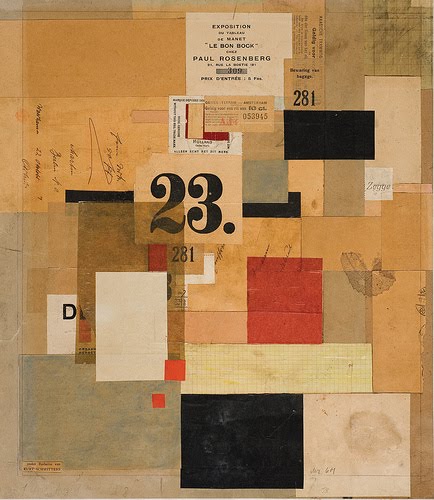
Art Mind: Kurt Schwitters and "Create" at the Berkeley Art Museum

Kurt Schwitters: Mz 601, 1923; paint and paper on cardboard; 17 × 15 in.;
Sprengel Museum, Hannover, loan from Kurt and Ernst Schwitters Stiftung.
© 2011 Artists Rights Society (ARS), New York / VG Bild-Kunst, Bonn.

My favorite art shows remind me of an open mind, a mind that is, at least for a time, not distracted by finances, traffic, children, and what author Walker Percy called "everydayness." A mind apart, completely focused on expression, on arranging or rearranging a small part of the universe. Some might call it a child’s mind. It is the purity of childhood combined with a lifetime of seeing.

The other night, I went to an opening at Creative Growth, an art center for the developmentally disabled a few blocks from our home in Oakland. Architect Anne Fougeron has guest curated a show called "Opposition/Composition." Most of the pieces had an architectural angle, but only as an organizing principle. Most of the pieces felt fresh, the result of an open mind at work.

Artist: Natascha Haehlen
Sculpture at the Opposition/Composition show
at Creative Growth curated by Anne Fougeron

Over the weekend, I went to see the Kurt Schwitters show at the Berkeley Art Museum and found that there was a concurrent show, "Create," with art from Creative Growth and two other similar art centers, Creativity Explored in San Francisco and the NIAD Art Center in Richmond. Mounting both shows simultaneously makes this small museum exciting. On the one hand, "Create" explicitly shows what are often referred to as outsider artists. Schwitters is now part of the canon, but he was also an outsider for most his life.

Kurt Schwitters: Untitled (okolade), 1926;
collage of cut printed, and marbleized papers on paperboard;
image: 3 7/8 x 2 7/8 in.;
the Menil Collection, Houston.
Photo: Janet Woodard, Houston.

Kurt Schwitters MERZ 1926,3. Cicero, 1926;
paint on wood nailed on wood; 26-7/8 x 19-5/8 x 3-1/8 in.;
Sammlung NORD/LB in der Niedersächsischen Sparkassenstiftung,
Sprengel Museum Hannover
Photo: Michael Herling / Aline Gwose,
Sprengel Museum Hannover © ARS New York.

Kurt Schwitters: Untitled (Silvery), 1939;
collage, silver paint and cardboard on paper on transparent paper;
7 7/8 x 6 1/8 in.;
Kurt und Ernst Schwitters Stiftung, Hannover.
Photo courtesy: Kurt Schwitters Archives at the Sprengel Museum Hannover.
Photographers: Michael Herling / Aline Gwose,
Sprengel Museum Hannover © ARS, New York

Although the structure of the Berkeley Art Museum has been compromised by necessary seismic interventions, it remains one of my favorite modern buildings in the Bay Area. It opened as I entered middle school, and I visited a number of times throughout the 1970s. The whole family took a rare outing together to see the Claes Oldenburg show in 1971, which opened my eyes to what modern art might be. (Melting electric plugs!) For several years, a few of us from high school made almost weekly trips to see the baffling Hans Hoffman canvases on the top floor. The gentle ascent on ramps between galleries allows the viewer to slow down, focus on art, and then reconnect with the shared space occupied by other viewers. You can also take the elevator to the top and work your way down. This is a perfect way to move between the Schwitters show and the "Create" artists to see if they create a dialog. Both shows are both up for a few more weeks.

Installation view of Create, curated by Lawrence Rinder with Matthew Higgs.
On view at the Berkeley Art Museum and Pacific Film Archive (BAM/PFA)
from May 11 through September 25, 2011.
Photo: Sibila Savage.

Berkeley Art Museum

Schwitters lived from 1887 to 1948. He enjoyed some recognition and success in his career in Germany in the era following World War I. However, after Hitler’s rise to power in 1933, Schwitters was ostracized and shown only in exhibitions of deviant art. Eventually he moved to Norway and later England, but was unable to rebuild his famous three-dimensional Merzbau or coalesce a movement around his ideas.

The artists participating in "Create" are mostly working at the beginning of this century and are considered outsiders because of their disabilities. Despite the decades separating Schwitters and these local artists, there are many commonalities. In some pieces, it is the juxtaposition of found objects or the surprising combinations of color and words or letters; in others, it is the apparent randomness that results in a balance just short of chaos. But all of the pieces show the unconscious at work. That moment when deliberation or intent gives way to pure action, pure joy—that moment when time is lost. I think this is what art philanthropist Dominique de Menil was after in her many curatorial projects. A hint of the divine. No surprise that the Schwitters show was organized by the Menil Collection.

Lance Rivers: Richmond San Rafael Bridge, 2010;
ink and ballpoint pen on wood; 8 5/16 x 14 1/2 in.;
courtesy of the artist and Creativity Explored, San Francisco.

Mary Belknap: Untitled, 2006;
acrylic on fabric; 27 3⁄4 × 16 1⁄2 in.;
courtesy of the artist and Creativity Explored, San Francisco.

James Montgomery: Untitled, 2007;
correction fluid pen, ink, and acrylic on paper; 22 × 29 1⁄2 in.;
courtesy of Creativity Explored, San Francisco.

Rarely do two shows speak to each other this well about unconscious motivations without trying to make literal connections. While it may be unlikely that many of the artists in "Create" know about Schwitters, they evidence a similar desire to make order.

In the lowest gallery is the most ambitious aspect of the Schwitters show, a rebuilding of his much loved (and forever lost) Merzbau, a three-dimensional collage environment that existed in Schwitters’ Hanover flat. (It was destroyed by Allied bombers in 1943.) It has been reconstructed from historic photographs. Not every piece is there, but the essence of the room envelops a few people at a time and transports them. Wandering through the space, I kept thinking this space was timeless. All of the artists are part of one great all-encompassing art mind.

Peter Bissegger: Reconstruction of Kurt Schwitters's Merzbau,
1981-83 (original ca. 1930-37, destroyed 1943);
154-3/4 x 228 3/8 x 181 in.;
Sprengel Museum Hannover.
Photo: Michael Herling / Aline Gwose,
Sprengel Museum Hannover (c) Peter Bisseger.

For more information:
http://en.wikipedia.org/wiki/Kurt_Schwitters
www.menil.org
www.creativityexplored.org
www.creativegrowth.org
http://niadart.org/
http://www.bampfa.berkeley.edu/